The Ultimate Beginner's Guide to Painting Backgrounds
So you've got your main subject ready to go, a killer portrait or a perfect pear. But what about the stuff *behind* it? That's the background, and it's more than just dead space. This guide shows you how to paint backgrounds that make your subject look awesome, not awkward.
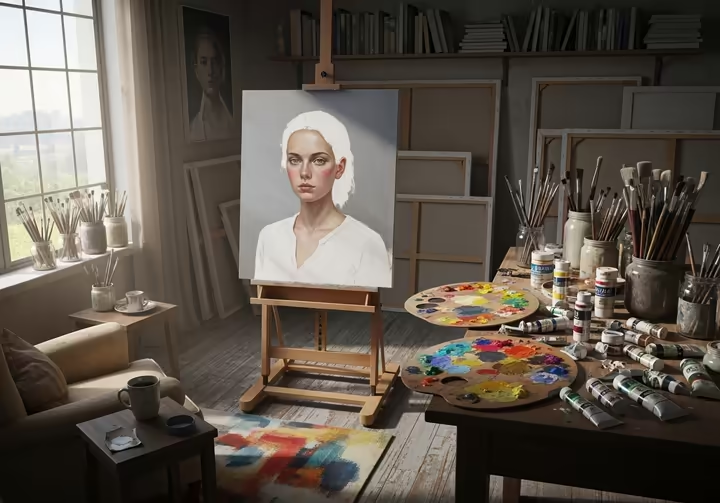
Why Bother with Backgrounds?
A background both sets the mood and tells a story, making your main subject look like it belongs there. A painting is a complete world inside a frame, not just a subject. Ignoring the background leaves your star player floating in a weird, empty void... kind of lonely.
Think of a single key. On a dark, velvet cloth, it's a mystery. On a sandy plank with the sea behind it, it's a pirate adventure. The key is the same, but the background changes the whole story.
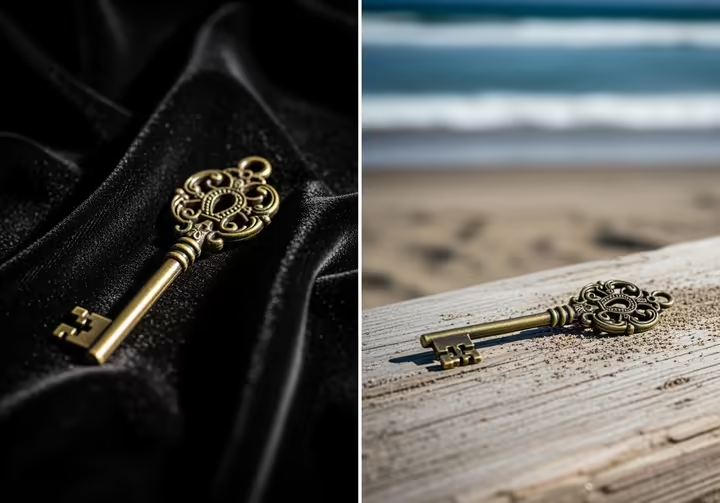
The background also controls the mood. Dark, shadowy colors create drama or intimacy (think Rembrandt portraits, all dark and serious). Light, soft colors feel joyful and airy. You get to choose the feeling.
The Basic Toolkit: Making It Look Good
Creating Depth (It’s Not Magic)
You want to make a flat canvas look like a deep, 3D world? The trick is called atmospheric perspective. It just means copying how air affects things we see from far away, as particles like dust and moisture scatter light.
Here’s how it works. First, contrast fades with distance, so objects up close should have your darkest darks and lightest lights, while things far away look paler. Second, colors get cooler and less saturated in the distance, so a bright green field up close becomes a hazy blue-green on a distant hill.

Third, details get blurry. You can’t see every leaf on a tree a mile away. Keep foreground details sharp and background details soft and simple. Easy.
Value and Tone: Light vs. Dark
Value is just art-speak for how light or dark a color is. It's your best tool for creating mood and directing the viewer's eye.
Want serious drama? Use chiaroscuro, an Italian term for "light-dark". It’s a technique that uses extreme contrast, placing a brightly lit subject against a super dark background to make your subject pop right out of the shadows.
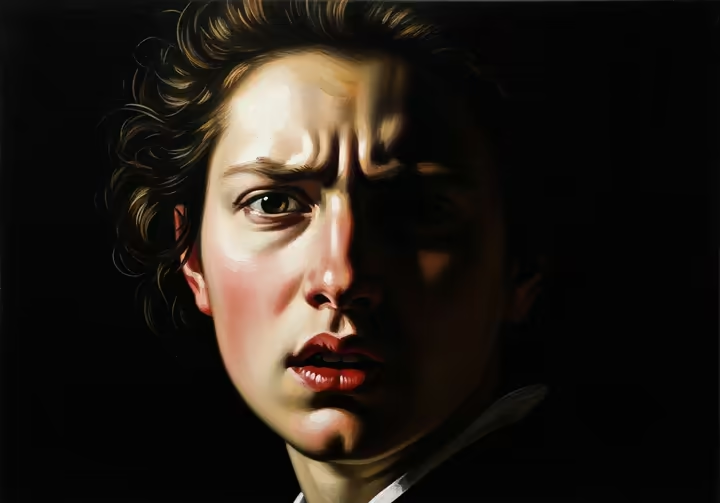
The opposite approach is a high-key painting, which uses mostly light and mid-tone colors with very few darks. A high-key background creates a feeling of airiness, joy, and calm. Deciding between a dark or light background is a basic choice about the story you want to tell.
Color Tricks
Color sets the emotional vibe, and a little color wheel knowledge goes a long way. To create energy and make your subject stand out, use a complementary color scheme. These are colors opposite each other on the wheel, like blue and orange, and they make each other look brighter.
For a calm, unified feeling, use an analogous color scheme. These are colors next to each other on the wheel, like yellow, yellow-green, and green. They naturally go together (think of a sunset) and make the scene feel peaceful.
Picking Your Paint: Acrylic, Watercolor, or Oil
Acrylics: Fast and Furious
Acrylics are great for beginners, they're vibrant and clean up with water. Their main feature? They dry super-fast. This can be good for layering, but tricky for creating smooth, blended backgrounds.
To create a blended gradient, you have to work fast while the paint is wet. Lay down your colors side-by-side, then use a clean, dry brush to gently sweep over the seam where they meet. You can also lightly mist your canvas with a spray bottle to buy yourself more working time, or add a "retarder" medium to slow things down.
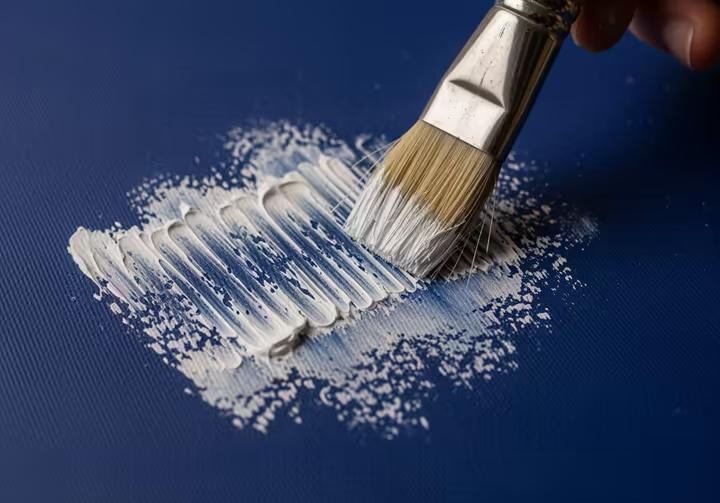
For texture, try the dry brush technique, also called scumbling. Put a tiny bit of thick paint on a dry brush, wipe most of it off, then scrub it over a dry surface. It leaves a scratchy, broken mark that's great for suggesting textures like weathered wood or grass.
Watercolor: Go with the Flow
A watercolor background is about working *with* the water. The paint is transparent, so light shines through it and bounces off the white paper, making it glow. The key is to control the water’s flow, or just let it do its beautifully unpredictable thing.
The classic technique for a soft background is the wet-on-wet wash. First, paint an area of your paper with clean water. Then, just touch your wet brush to the wet paper and watch the color bloom and spread in soft, organic patterns.
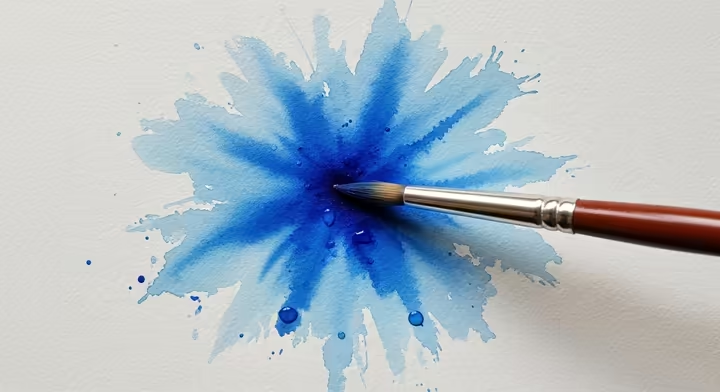
For a more controlled fade, like a sky, use a graded wash. Prop your paper at an angle, paint a stroke at the top, and let the paint form a little puddle (a 'bead'). Then pick up that bead with your next stroke, adding a bit more water to your brush each time to lighten the color.
Oils: All the Time in the World
Oil paint is famous for its rich color and slow drying time, its main advantage. Oils can stay wet for hours or even days, giving you plenty of time to blend a perfect, seamless background. This makes blending a much more forgiving process.
The slow drying time lets you create smoky, soft transitions called sfumato, a technique perfected by Leonardo da Vinci. You just blend the colors right there on the canvas until the edge between them disappears. This is how you achieve realistic atmospheric effects.
Oils are also amazing for glazing, which is applying thin, see-through layers of paint over a dry layer. Each glaze changes the color underneath, creating deep, luminous colors you can't get by just mixing on a palette. This is how you get those rich, alive-looking dark backgrounds, building them up with layers of dark blues and browns instead of just plain black.
| Feature | Acrylics | Watercolors | Oils |
|---|---|---|---|
| Key Property | Fast-drying, opaque, vibrant. | Water-based, transparent, luminous. | Slow-drying, rich, blendable. |
| Blending | Tricky. Blend fast while it's wet, use a sponge, or add a 'retarder' medium to slow it down. | Excellent for soft blends. Relies on water control with wet-on-wet and graded wash techniques. | Easiest. You have ages to blend colors smoothly right on the canvas (sfumato). |
| Layering | Excellent. Dries quickly, allowing for rapid layering of opaque colors. | Challenging. Layers are transparent (glazes), and disturbing lower layers is a risk. | Methodical. Layers (glazes) must be applied over completely dry underlayers, which can take days. |
| Best For... | Bold, graphic, or highly textured backgrounds. Quick paintings and experiments. | Soft, ethereal, and atmospheric backgrounds. Expressive and spontaneous effects. | Rich, deep, and seamlessly blended backgrounds. Realistic and traditional styles. |
| Your Mission | Work quickly. Embrace texture and opacity. | Let go and partner with the water. Embrace transparency. | Be patient. Enjoy the slow process of building layers. |
Getting Started: Prepping Your Canvas
First, Prime Your Canvas (Or Don't)
Most store-bought canvases come pre-primed with gesso, a white paint-like substance. It seals the canvas and gives the paint something to grab onto, so it doesn't just soak in and look dull. Some artists add another coat or two of gesso for an even smoother surface to work on.
Escaping the Tyranny of White: Tone Your Canvas
Painting on a stark white canvas is tough, it can trick your eye and make it hard to judge colors correctly. The fix is toning the canvas. Just apply a thin, transparent wash of a single neutral color (like a light gray or a brownish color called burnt sienna) over the whole thing.
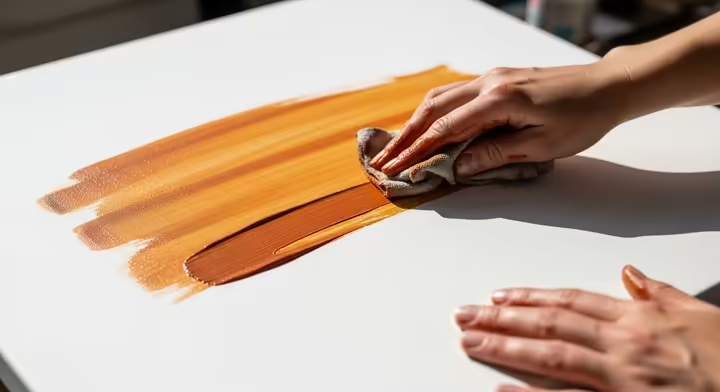
This toning layer is called an imprimatura. It kills the scary white glare, gives you a nice mid-tone to judge your other colors against, and unifies the whole painting since bits of it will peek through the final layers.
Use a big brush or a clean rag to scrub this thin wash over the canvas. It doesn't need to be a perfectly flat coat. In fact, a slightly varied application can add a subtle energy from the very beginning.
Background Ideas: From Real to Abstract
A Quick History Lesson
Back in the Middle Ages, religious paintings often had backgrounds made of real gold leaf. The gold wasn't meant to be realistic, it was a symbol for the divine, otherworldly light of heaven. The background was a flat, glorious idea.
Then came the Renaissance, when artists got obsessed with making things look real. Masters like Leonardo da Vinci developed tools like linear and atmospheric perspective. Suddenly, the background was a deep, believable landscape, like the mysterious, misty world behind the Mona Lisa .
The Sky as a Background: Painting Air and Light
The sky is a classic background, but don't just paint it one flat blue. A real sky is a gradient, it's typically darkest and most saturated directly overhead and gets lighter as it approaches the horizon. Nailing this simple fade will instantly make your landscapes look better.

As for clouds, think of them as 3D shapes, not white blobs. They have a side lit by the sun and a side in shadow. Keep their edges soft and wispy, and don't try to paint every detail, just suggest their puffy form and the way light hits them.
Abstract and Textural Moods: Painting an Emotion
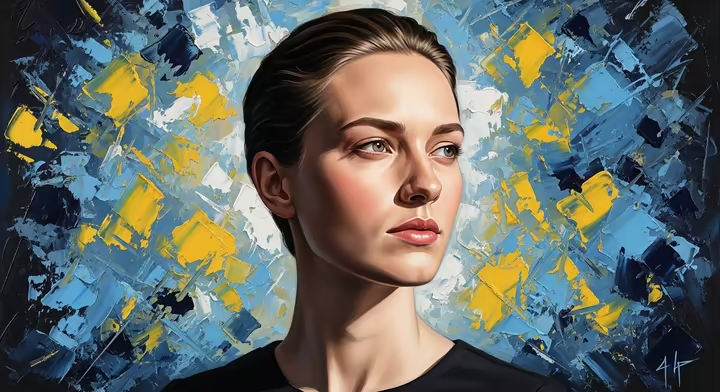
A background doesn't have to be a literal place. Sometimes an abstract background that uses color, shape, and texture is the best way to create a mood that supports your subject.
For an energetic portrait, you might create a background of bold, expressive brushstrokes. For a serene floral painting, a soft, blended gradient could provide the perfect atmosphere. You can even add physical texture by applying thick paint with a palette knife or stamping patterns with objects like sponges or crumpled paper.
Simple Representational Spaces: The Still Life Setting
For still life or portrait painting, a simple background like a plain wall or a draped cloth is often the most effective choice. But simple doesn't mean boring. You can bring these spaces to life with subtle shifts in light and shadow.
A background wall, for instance, can be painted with a gentle gradient to suggest that light is coming from one side. This creates a sense of space without adding distracting details. The main rule is to keep the background secondary, with less detail and lower contrast than your main subject, so it can do its supportive job perfectly.
Putting It All Together
The Final Unification: Lost and Found Edges
Okay, final trick. To make your subject and background look like they're in the same world, you need to play with edges. This is called "lost and found edges," and it's key to making your subject feel naturally placed in its environment.
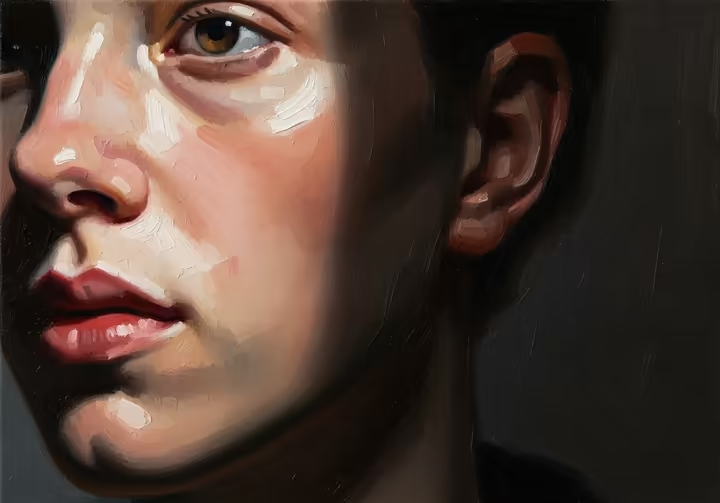
A "found edge" is hard and sharp, which draws the eye. Use these sparingly at your focal point. A "lost edge" is soft and blurry, where the subject and background seem to melt together, usually in the shadows where an object turns away from the light.
Varying your edges makes things look three-dimensional and real, not like a cardboard cutout glued onto a backdrop. In a portrait, the side of the nose catching the light might have a sharp edge, while the side of the face turning into shadow should have a soft edge that merges with the background.
Leading the Eye: The Supportive Role
Remember, the background's job is to support the main subject, not steal the show. Every element in the background should help guide the viewer's eye to your focal point. You can use the lines of a landscape to point toward a figure, or the shadows of a room to frame a still life.
A good trick is to make the corners and edges of your background slightly darker. This creates a natural vignette effect that gently pushes the viewer's attention toward the brighter, more detailed center of the composition where your subject lives.
And that’s it. You've learned the theory, now it's time to paint. Don't be afraid to make a mess or try something weird. Every painting is just practice, and the only way to get better is to... well, paint. Go for it.
Works cited
- I never know what to do with the background of portraits... does anyone have advice? I run into this issue with every portrait I do... a lot of time I make it too dark but maybe it works for a lighter dog?? : r/learnart - Reddit, https://www.reddit.com/r/learnart/comments/99caiw/i_never_know_what_to_do_with_the_background_of/
- Why Backgrounds Are Important in Art | Online Art Lessons, https://onlineartlessons.com/tutorial/why-backgrounds-are-important-in-art/
- The Role Of Background In Art Composition - Chris Wilson, https://chriswilsonstudio.com/background-in-art/
- Storytelling in Art - Saint Louis Art Museum, https://www.slam.org/teachers-students/virtual-field-trips/storytelling-in-art/
- Telling A Story In Your Paintings or Drawings Using Backgrounds (With Examples), https://pekoeblaze.wordpress.com/2016/01/10/telling-a-story-in-your-paintings-or-drawings-using-backgrounds-with-examples/
- Color: How It Changes the Mood in Art - Google Arts & Culture, https://artsandculture.google.com/usergallery/color-how-it-changes-the-mood-in-art/XgKSfPrv2f5sIQ
- 3 Key Tips for Mastering Atmospheric Perspective, https://www.virtualartacademy.com/atmospheric-perspective/
- How to Create Atmospheric Perspective in a Landscape Painting ..., https://samuelearp.com/blog/how-to-create-atmospheric-depth-in-a-landscape-painting/
- Examples of Value in Art (A Visual Guide!) - Watercolor Affair, https://www.watercoloraffair.com/examples-of-value-in-art/?tva_skin_id=32
- A Chiaroscuro Portrait - PIXLS.US, https://pixls.us/articles/a-chiaroscuro-portrait/
- Chiaroscuro: Harnessing the Power of Strong Contrast in Painting ..., https://www.angelaedwards.co.uk/chiaroscuro-harnessing-the-power-of-strong-contrast-in-painting/
- A BEGINNER'S GUIDE TO COLOR THEORY FOR CONCEPT ..., https://masterclasses.iamag.co/pages/a-beginners-guide-to-color-theory-for-concept-artists
- Analogous Colours vs. Complementary Contrasts: A Watercolour ..., https://www.kerriewoodhouse.com/blog/analogous-colours
- Intimidated by the Blank Page? 5 Acrylic Background Techniques for ..., https://hopalongstudio.com/intimidated-by-the-blank-page-5-acrylic-background-techniques-for-the-art-journal/
- 14 Acrylic Painting Techniques That Beginners Should Try, https://www.paintingtogogh.com/blogs/news/acrylic-painting-techniques
- The EASY Way to Blend Acrylic Paints | How to Blend Acrylics on Canvas - YouTube, https://www.youtube.com/watch?v=nybo6wu6kro
- Blending Acrylic Paint on Canvas - EASY Gradient Art - YouTube, https://www.youtube.com/watch?v=VKYUgLHSLVw
- How to blend acrylic paint? : r/acrylicpainting - Reddit, https://www.reddit.com/r/acrylicpainting/comments/swfwhd/how_to_blend_acrylic_paint/
- Can You Explain the Dry Brush Technique? | Answers by Jed Dorsey, https://www.acrylicuniversity.com/blog/can-you-explain-the-dry-brush-technique
- How to: Use the Dry Brush Painting Technique - Annie Sloan, https://www.anniesloan.com/us/techniques/how-to-use-the-dry-brush-painting-technique/
- Easy Wet-on-Wet Watercolor Techniques for Beginners - Hop-A ..., https://hopalongstudio.com/easy-wet-on-wet-watercolor-techniques-for-beginners/
- Why are my graduated washes not smooth? : r/Watercolor - Reddit, https://www.reddit.com/r/Watercolor/comments/11j5b31/why_are_my_graduated_washes_not_smooth/
- Old Masters: painting tricks - Tanja Moderscheim, https://www.dutchfinepaintings.com/old-masters-painting-tricks/
- Renaissance Art to the Modern Age: A Deep Dive into Art History ..., https://www.sothebysinstitute.com/how-to-series/art-history
- Sfumato - Wikipedia, https://en.wikipedia.org/wiki/Sfumato
- en.wikipedia.org, https://en.wikipedia.org/wiki/Sfumato#:~:text=Sfumato%20(English%3A%20%2Fsf,out%2Dof%2Dfocus%20plane.
- Glazing and Scumbling – How, Why and When | Jackie Garner's Art ..., https://garnerwildlifeart.wordpress.com/2022/06/03/glazing-and-scumbling-how-why-and-when/
- Secrets of the Old Masters: Glazing and Scumbling (Part 3) - CIRIUS, https://www.cirius-s.com/single-post/secrets-of-the-old-masters-glazing-and-scumbling-part-3
- www.art-is-fun.com, https://www.art-is-fun.com/what-is-gesso#:~:text=Gesso%20is%20very%20similar%20to,the%20weave%20of%20the%20canvas.
- What is Gesso: Everything You Need to Know About How to Prime ..., https://www.art-is-fun.com/what-is-gesso
- How to Tone a Canvas - Art by Cedar Lee, https://www.artbycedar.com/how-to-tone-a-canvas/
- Why Toning The Canvas Sets The Stage For A Masterful Painting ..., https://www.chuckblackart.com/blogs/the-painters-block/why-toning-the-canvas-sets-the-stage-for-a-masterful-painting
- Toning and Underpainting A Canvas - Painting With Acrylics 101, https://paintingwithacrylics101.com/toning-and-underpainting-a-canvas/
- How to Tone a Canvas for Oil and Acrylic Painting - Fine Art Tutorials, https://finearttutorials.com/guide/how-to-tone-a-canvas-for-oil-and-acrylic-painting/
- How to Make an Imprimatura - YouTube, https://www.youtube.com/watch?v=Y5cGIOHbCC4
- Painting the Imprimatura - Damian Osborne, https://www.damianosborne.com/painting-the-imprimatura
- www.chuckblackart.com, https://www.chuckblackart.com/blogs/the-painters-block/why-toning-the-canvas-sets-the-stage-for-a-masterful-painting#:~:text=The%20answer%20to%20this%20is,water%20to%20thin%20the%20paint.
- How to tone canvas - Acrylic Painting 101 with Shelby - YouTube, https://www.youtube.com/watch?v=frReytyJpKc
- On Goldleafing | Studio Museum in Harlem, https://www.studiomuseum.org/magazine/on-goldleafing
- How to collect gold-ground artworks from the early ... - Christie's, https://www.christies.com/en/stories/gold-ground-paintings-collecting-guide-ffbbfd9636fd42f091a8803b358d6a73
- Gold ground - Wikipedia, https://en.wikipedia.org/wiki/Gold_ground
- Colour in art: a brief history of gold | Art UK, https://artuk.org/discover/stories/colour-in-art-a-brief-history-of-gold
- Renaissance art | Definition, Characteristics, Style, Examples ..., https://www.britannica.com/art/Renaissance-art
- Renaissance art - Wikipedia, https://en.wikipedia.org/wiki/Renaissance_art
- Art in the Italian Renaissance Republics, c. 1400–1600 - Smarthistory, https://smarthistory.org/reframing-art-history/art-italian-renaissance-republics/
- Renaissance Art: History, Characteristics, and Examples - 2025 ..., https://www.masterclass.com/articles/renaissance-art-guide
- Genealogies of Modernity — On Background: From the ..., https://genealogiesofmodernity.org/journal/2021/3/3/on-background-zoom-and-the-italian-renaissance-portrait
- Painting Backgrounds for beginners: How to paint a sunny sky with ..., https://paintingdreamscapes.com/painting-backgrounds-sunny-sky/
- Painting a Sky full of Clouds with Acrylics in 10 Minutes! - YouTube, https://www.youtube.com/watch?v=YflgqLdO_G8
- 770 Textured Paintings ideas | abstract, texture painting, abstract ..., https://www.pinterest.com/studiospindler/textured-paintings/
- Abstract Painting Background stock illustrations - art - iStock, https://www.istockphoto.com/illustrations/abstract-painting-background
- Still Life Techniques - Painting the Background and Foreground, https://www.artyfactory.com/still-life/still-life-painting-the-background.html
- Paint a Simple Still Life Part 1 - Artists & Illustrators, https://www.artistsandillustrators.co.uk/how-to/oil-painting/paint-a-simple-still-life-part-1/
- How to Paint a Warm & Cool Still Life Painting – 3/3, https://willkempartschool.com/how-to-paint-a-warm-cool-still-life-painting-using-only-2-colours-part-3/
- Quick Tip 446 - Still Life Background Colors - YouTube, https://www.youtube.com/watch?v=jNPiF3Lo5GY
- How to Paint Lost and Found Edges in Watercolour — Louise De ..., https://www.louisedemasi.com/tips/2023/11/23/how-to-paint-lost-and-found-edges-in-watercolour