Monochrome Art: A Guide for Beginners
Thinking of making art but scared of color theory? Good news. You can just... not use it. Making art with one color (monochrome!) isn't a cop-out, it's a secret weapon for learning the basics and making powerful stuff right away.
What is Monochrome Art?
"Monochrome" literally means ‘one color’ from the Greek words monos (one) and khrôma (color). 1 A monochrome artwork uses just one color and all its variations. Easy peasy.
Most people think monochrome just means black and white... and it does! But it can also be all blues, or all reds, or all-any-single-color-you-want. 1 A painting done only in shades of red is monochrome.
You get variety by playing with that one color. Add white to make a 'tint' (lighter). Add black to make a 'shade' (darker). 4 Add grey to make a 'tone' (less vibrant or saturated). 4
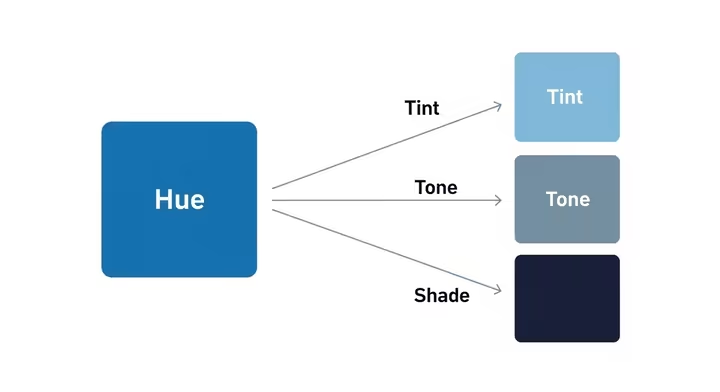
The whole point is that you can create something complex and emotional with just one color. You do it by skillfully playing with how light or dark that one color gets. It's a focused approach that gives monochrome art its power. 2
Why Bother With Just One Color?
Artists use limited palettes to make their work more potent. Taking color away forces you (and anyone looking at your art) to focus on other things. Things like shape, texture, composition, and how light and shadow play together. 5
This approach can create a huge range of emotions. High contrast between light and dark can feel dramatic or mysterious. 5 Low contrast feels softer and calmer. 5 Many find black-and-white art has a nostalgic, timeless quality. 5
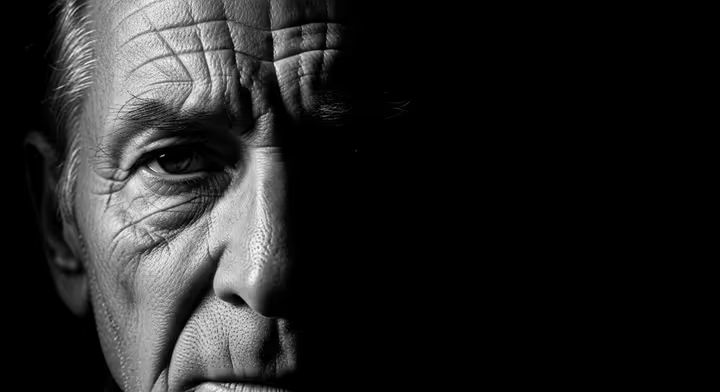
It can also give a subject clarity and seriousness. Pablo Picasso’s famous painting Guernica uses a grayscale palette to show the horrors of war. Adding color might have just diluted the message. 6
For a beginner, too many color choices can be paralyzing. 8 Sticking to one color frees you up to nail down the basics of light, dark, and shape. 8 These are the skills that make all art work, even the super colorful stuff. 10
A (Very) Quick History
Monochrome art is as old as art itself. Think of those prehistoric cave drawings made with charcoal on rock walls. 11 That's monochrome, baby! 12
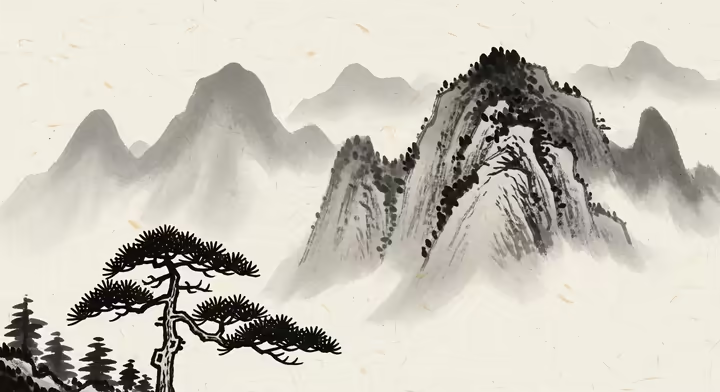
Later, ink wash painting popped up in East Asia. Artists used different amounts of black ink to capture the "spirit" of a subject, not just what it looked like. 14 This style was tied to poetry, calligraphy, and Zen Buddhist philosophy.
In Europe, Renaissance artists like Caravaggio got obsessed with chiaroscuro , a fancy Italian word for dramatic light-dark contrast. 15 They also used grisaille , which is just painting the whole thing in shades of grey first. This let them figure out the lighting before adding thin layers of color on top. 17
Then photography was invented, and it was black-and-white for a long time. 1 Photographers like Ansel Adams proved you don't need color to capture dramatic scenes. 7 Film and photography still use monochrome today for a timeless or nostalgic feel. 2
Modern artists took it even further. Kazimir Malevich’s Black Square and Yves Klein's all-blue paintings used a single color to explore pure feeling and the very essence of art. 19, 20
The Basic Ingredients
Working in monochrome is a crash course in the most important parts of art. With color out of the way, you can focus on the core principles.
Value and Contrast
The most critical thing to learn is 'value', which is just how light or dark a color is. 22 Practice making a value scale, a strip that goes from pure white to pure black with all the grays in between. 23 This skill is how you make a flat circle look like a 3D sphere. 23
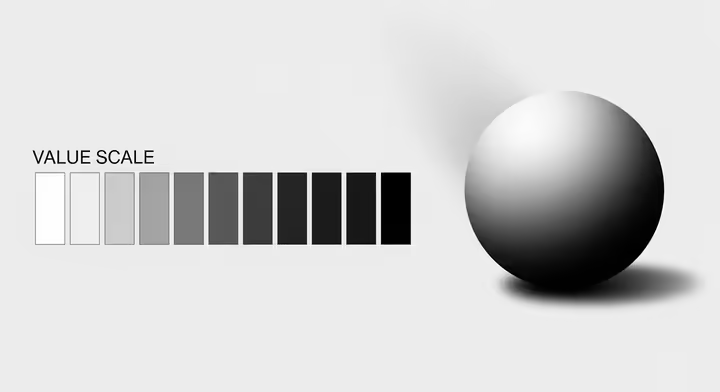
'Contrast' is just the difference between your lightest and darkest areas. 24 High contrast is dramatic and grabs attention. 24 Low contrast, with a smaller range of values, is subtle and calm. 5
Form and Space
With no color to distract the eye, the arrangement of shapes (the composition) becomes super obvious. 25 You can really see the "bones" of the artwork. 25
Pay attention to 'negative space', the empty areas around your subject. 25 In monochrome art, this space is an active element that helps create balance and elegance. 26
Texture
Monochrome is great for practicing texture. Texture can be the actual physical feel of the art, or the illusion of feel you create. 24 Using different lines, marks, and values, you can make something look rough like stone or soft like cloth. 26
Tools of the Trade
Getting started is easy. Each tool gives you a different feel, but the ideas are the same.
Drawing: Graphite and Charcoal
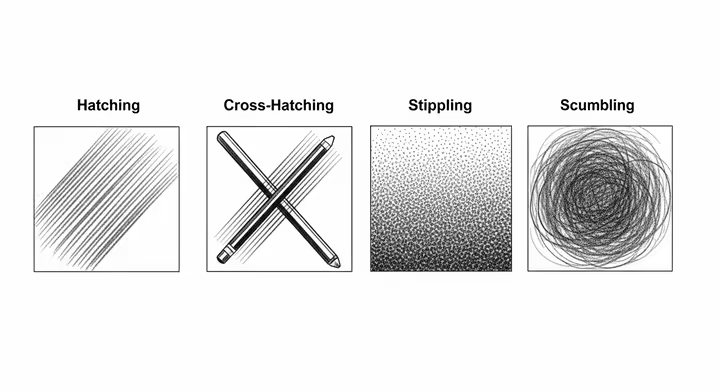
For drawing, graphite and charcoal are your best friends. 26 Graphite pencils come in different hardnesses, from 'H' for light lines to 'B' for dark, smudgy ones. 23 Use techniques like hatching (parallel lines) and cross-hatching (overlapping lines) to build up shadows. 26
Charcoal gives you deep, rich blacks and is great for big, expressive drawings. 26 Vine charcoal is soft and easy to erase, while compressed charcoal makes a darker mark. 28 You can even use a kneaded eraser to pull out highlights, like drawing with an eraser. 28
Drawing: Ink
Pen and ink give you crisp lines and detailed textures. 26 But you can also do an 'ink wash' by watering down black ink to create different shades of gray. 30 You build up the darkness in layers from light to dark, sort of like a watercolor painting. 30
Painting
If you're painting, try using just one color like Burnt Umber, Payne's Grey, or Indigo, plus black and white paint. 3 This lets you focus on form without stressing about complex color mixing. 18
A classic technique is the grisaille underpainting. 18 You paint the entire picture in gray or brown tones first to get the light and shadow right. 17 Then, you can add thin, transparent layers of color on top. 18
Your First Step into Art
Starting out in art can feel like juggling too many things at once. 6 Monochrome simplifies the game. It lets you put color aside for a minute to focus on what really matters. 10
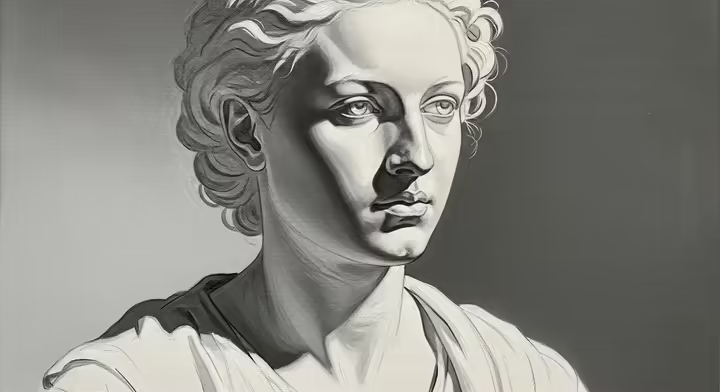
You'll train your eye to see in terms of light and dark, what artists call 'value'. 6 This is the secret sauce that makes images look 3D and not flat. 22 It's a skill you'll use forever, even when you go back to using a zillion colors. 22
It builds confidence by letting you solve one puzzle at a time. A drawing with a good light-dark structure will look great, regardless of the color palette. 6 Mastering these essentials first will make your work stronger from the get-go. 10
Common Questions (and Answers)
You've got questions? We've got answers. Let's clear up some common mix-ups.
First up: Is "black and white" the same as "monochrome"? Short answer- no. All black and white art is monochrome, but not all monochrome art is black and white. 1 Remember, 'mono' means one... any one color will do. 1
"Can a monochrome painting be blue?" Yep! 3 A painting made with only shades of blue is a monochrome painting. An all-pink one? Also monochrome. 4 You get the idea.
"How do I create depth?" By using a full range of values, from your lightest lights to your darkest darks. 2 Put dark things next to light things to make them pop. 29 Also, make objects in the distance lighter and less detailed, that’s called atmospheric perspective. 2
"What's 'grisaille' again?" It's a fancy word for a painting done entirely in one color, usually gray or brown. 17 It's often used as the first layer of a painting to figure out all the shadows and highlights before adding color. 18 It's a great way to practice value. 17
So basically, working with one color gives you a clear path to getting good at the fundamentals. Focus on value, contrast, and form. Master these, and you're set for your entire artistic journey.
Works cited
- Monochrome - Wikipedia, https://en.wikipedia.org/wiki/Monochrome
- Monochrome in Art: Exploring the beauty of one color in Art - - Whataportrait, https://www.whataportrait.com/blog/monochrome-in-art/
- Monochrome Artwork Basics | Online Art Lessons, https://onlineartlessons.com/tutorial/monochrome-artwork-basics/
- Tint, shade and tone - Wikipedia, https://en.wikipedia.org/wiki/Tint,_shade_and_tone
- The Psychology of Black & White: Why Less Color Creates More Impact - artisCHt, https://artischt.com/blogs/journal/the-psychology-of-black-white-why-less-color-creates-more-impact
- Exploring the Power of Monochrome in Your Artwork - Altenew, https://altenew.com/blogs/the-creative-corner/exploring-the-power-of-monochrome-in-your-artwork
- The Language of Light and Shadow: Visual Storytelling in Monochrome - Eden Gallery, https://www.edenart.com/news/the-language-of-light-and-shadow-visual-storytelling-in-monochrome
- The Benefits of Using a Limited Colour Palette - Louise De Masi Watercolour Art, https://www.louisedemasi.com/tips/2023/11/6/benefits-of-using-a-limited-colour-palette
- Why Limited Color Palettes Make Your Art BETTER! - Willa Wanders, https://www.willawanders.com/blog-posts/mixed-media-collage-art-limiting-color-palette
- Exploring Black-and-White Illustration: The Power of Monochrome Art | RMCAD, https://www.rmcad.edu/blog/exploring-black-and-white-illustration-the-power-of-monochrome-art/
- Prehistoric Colour Palette: Paint Pigments Used by Stone Age Artists - Visual Arts Cork, http://www.visual-arts-cork.com/artist-paints/prehistoric-colour-palette.htm
- Charcoal Drawings During the Stone Age: ArtsLookUp.com, https://www.artslookup.com/prehistoric/charcoal-drawings-stone-age.html
- East Asian Ink-and-Wash Painting - Artsy, https://www.artsy.net/gene/east-asian-ink-and-wash-painting
- Ink wash painting - Wikipedia, https://en.wikipedia.org/wiki/Ink_wash_painting
- Chiaroscuro | Definition, Art, Examples, & Facts - Britannica, https://www.britannica.com/art/chiaroscuro
- Chiaroscuro - Wikipedia, https://en.wikipedia.org/wiki/Chiaroscuro
- Grisaille | National Galleries of Scotland, https://www.nationalgalleries.org/art-and-artists/glossary-terms/grisaille
- What Is Grisaille In Classical Oil Painting? Step-By-Step Guide, https://www.kitschmeister.com/post/what-is-grisaille-in-classical-oil-painting-step-by-step-guide
- Monochrome painting - Wikipedia, https://en.wikipedia.org/wiki/Monochrome_painting
- Monochrome - Tate, https://www.tate.org.uk/art/art-terms/m/monochrome
- Monochrome: Painting in Black and White - National Gallery, https://www.nationalgallery.org.uk/about-us/press-and-media/press-releases/monochrome-painting-in-black-and-white
- What Is Value in Art and Why Is It So Important? - Draw Paint Academy, https://drawpaintacademy.com/what-is-value-in-art/
- Value Scale Drawing - A Practical Beginner's Guide, https://www.howtopracticedrawing.com/blog/value-scale-drawing
- What's Contrast in Art and How to Use It Effectively? - Artful Haven, https://artfulhaven.com/contrast-in-art/
- The Black and White Composition - NANPA, https://nanpa.org/2017/04/02/the-black-and-white-composition/
- The Art of Monochromatic Drawing - Number Analytics, https://www.numberanalytics.com/blog/the-art-of-monochromatic-drawing
- How To Create Believable Texture In Black And White Drawings? - YouTube, https://www.youtube.com/watch?v=I-eBA6N4p_I
- Help with using charcoal? I normally use graphite, but when I use charcoal everything looks kinda horrible. The differences between tones seem to evarate and i feel i dont really know what im doing. Any advice? : r/learnart - Reddit, https://www.reddit.com/r/learnart/comments/2jjk0n/help_with_using_charcoal_i_normally_use_graphite/
- Graphite, Charcoal, Carbon Pencil Drawing Tutorial., https://www.jdhillberry.com/how_to_draw%20step%20by%20step_pg3.htm
- How to Ink Wash: 14 Steps (with Pictures) - Painting - wikiHow, https://www.wikihow.com/Ink-Wash
- How to Paint with One Color: A Monochrome Sketchbook Tutorial, https://www.marinatvb.com/blog/a-monochrome-sketchbook-tutorial