Understanding Light in Art: A Beginner's Guide to History, Theory, and Practice
This guide explains how artists use light to create form, mood, and depth. It covers the history of light in art, the scientific principles of light and shadow, and practical techniques for drawing and painting.
1. Introduction: Why Light is Important in Art
How Light Creates Mood and Meaning
A single beam of sunlight cutting through a dusty attic or a spotlight on a stage demonstrates the power of light. It directs attention and creates emotion. Light both illuminates and makes us feel.
In art, light is used to tell a story. A soft, diffused glow can create a mood of peace, while sharp, high-contrast light can create drama and tension. 1 Artists use light as an active tool to guide the viewer's eye, build composition, and create the illusion of three dimensions.
Defining Light and Value
Two fundamental concepts are light and value .
- Light is the physical energy from a source, like the sun or a lamp, that illuminates a scene. We see the light that objects reflect into our eyes. 2 An object itself doesn't change when the lights go out, but our experience of it does. This is a crucial distinction: artists paint the effect of light on things, not the things themselves. 3
- Value is the artistic term for the lightness or darkness of a color. 2 It is a grayscale spectrum from the brightest white to the deepest black. The ability to see and arrange different values correctly is what creates the illusion of three-dimensional form.
Why Mastering Light is a Critical Skill
The behavior of light is governed by the laws of physics. This means light is a skill you can learn and master through observation and practice. 3
Understanding how light works separates a flat, lifeless drawing from one that appears solid and real. It allows an artist to represent a three-dimensional world on a two-dimensional surface. Learning to see and depict light allows an artist to create form, depth, atmosphere, and emotion. It is a critical artistic skill.
2. A Short History of Light in Art: From Symbol to Science
The way artists have depicted light has changed dramatically throughout history. This change reflects shifts in how people have seen the world, from the spiritual realm to the scientific one.
Ancient & Medieval Art: The Light of God
In early Western art, light was symbolic, not realistic. For medieval Christian artists, light was an emanation from God, the "Father of Lights". 5 Its purpose was to represent the holy and the divine, not a natural scene.
This is visible in the glittering, solid gold-leaf backgrounds of Byzantine icons. The gold did not represent a sunlit sky; it created an eternal, non-earthly space. Theologians had specific terms for light's divine qualities, such as claritas (purity) and splendor (luminous glow). 5
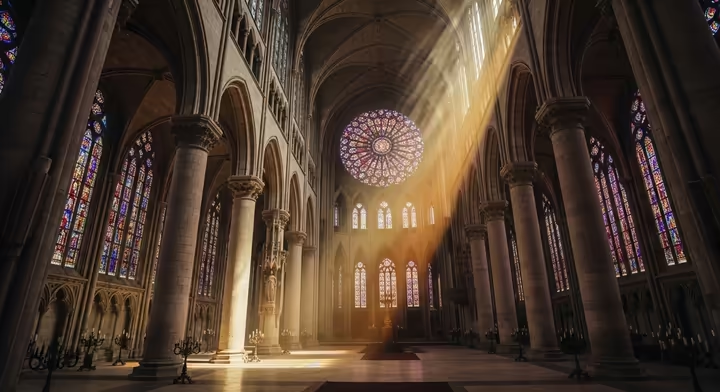
Stained-glass windows in Gothic cathedrals streamed colored light into stone interiors, transforming the space. This was theology made visible, designed to give the faithful a direct experience of God's holy light. 5
The Renaissance Revolution: The Birth of Realism
The Renaissance focus on humanism, science, and the natural world shifted art from the symbolic to the observable. Artists wanted to understand and replicate how light worked, which led to the development of realism.
Modeling Form: The Invention of Chiaroscuro
The key technique that emerged was chiaroscuro (pronounced kee-AH-roh-SKOO-roh ). This Italian word, combining chiaro (light) and scuro (dark), refers to the use of strong contrasts between light and shadow to model three-dimensional forms (Baur 1954; 6 ). Instead of a flat figure defined by lines, artists could create the illusion of a rounded, solid body by showing how light wrapped around it, leaving shadows in its wake. This technique was a significant advance in creating realistic images.
Leonardo da Vinci and Sfumato
Leonardo da Vinci fused art and science in his studies of light and optics. He pioneered a technique called sfumato , from the Italian word sfumare , meaning "to evaporate like smoke". 7
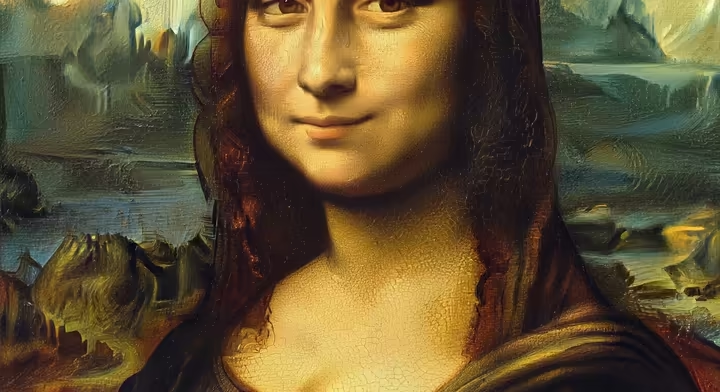
Sfumato is the technique of using soft, hazy, and imperceptibly blended tones to eliminate harsh outlines. 7 The smile of his Mona Lisa is an example; there are no hard lines defining her lips, which seem to melt into the shadows. Leonardo used sfumato in landscapes to create what he called aerial perspective , the effect of the atmosphere making distant objects appear blurrier, less detailed, and paler in color. 8 This approach was the logical outcome of a new scientific mindset: art was now about observing and depicting the world.
The Baroque Masters: The Drama of Darkness
In the 17th century, Baroque artists used light for greater dramatic effect. Fueled by the Catholic Church's Counter-Reformation, which sought emotionally resonant art, they used darkness to heighten the drama.
What is the difference between chiaroscuro and tenebrism?
This is where we meet tenebrism , a style that pushes chiaroscuro to an extreme. While chiaroscuro uses light and shadow to model form, tenebrism uses darkness as its primary element. The term comes from the Italian tenebroso , meaning "dark" or "gloomy" (Wikipedia 2025a). In a tenebrist painting, the background is plunged into blackness, and figures emerge dramatically as if caught in a spotlight. 10
Here’s a simple breakdown:
| Feature | Chiaroscuro | Tenebrism |
|---|---|---|
| Primary Goal | To model three-dimensional form and create realism. | To create intense drama and theatricality. |
| Use of Darkness | Darkness is used to create shadows and define form. | Darkness dominates the canvas; subjects emerge from a dark background. |
| Light Source | Often appears natural and integrated into the scene. | Acts like a harsh spotlight, creating extreme, sharp contrasts. |
| Overall Mood | Realistic, grounded, volumetric. | Dramatic, mysterious, intense, stage-like. |
| Key Artist | Leonardo da Vinci (High Renaissance) | Caravaggio (Baroque) |
The Pioneers of Dramatic Light
- Caravaggio (1571-1610): The pioneer of tenebrism was Michelangelo Merisi da Caravaggio. His paintings were known for their intense, gritty naturalism and drama (Bell 1993; 9 ). He would pose live models in a dark room with a single overhead light, painting scenes that felt immediate and real. His followers, the Caravaggisti , spread this dramatic style across Europe (Oxford Art Online n.d.).
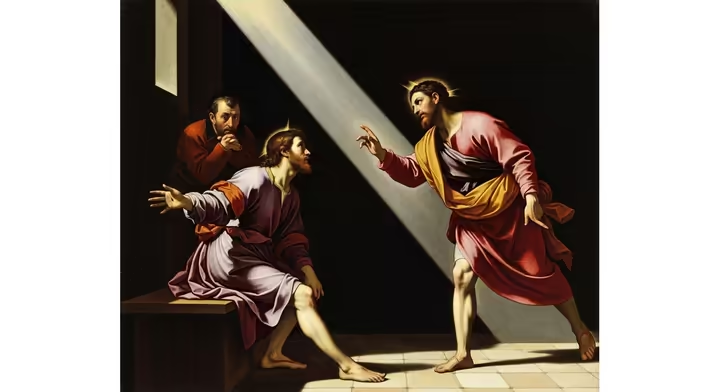
- Artemisia Gentileschi (1593-1656): A brilliant follower of Caravaggio, Artemisia Gentileschi used tenebrism for psychological power. In her work, Judith Slaying Holofernes , the stark light and deep shadows heighten the brutal physicality and emotional intensity of the scene, creating a statement of female strength and agency. 11
- Georges de La Tour (1593-1652): This French painter used deep shadows, but his famous candlelight scenes are marked by quiet and tranquility. In works like The Penitent Magdalen , the single flame creates a soft, meditative mood, focusing on spiritual contemplation rather than violent action. 14 His light is serene, not shocking.
- Rembrandt van Rijn (1606-1669): The Dutch master Rembrandt used light and shadow to explore human psychology. His use of chiaroscuro revealed the inner life of his subjects. In his many self-portraits, light carves his face out of the darkness, highlighting the textures of aging skin and conveying a lifetime of wisdom and vulnerability. 16
How did old masters like Caravaggio and Vermeer paint light so realistically?
Caravaggio achieved his gritty realism through direct, intense observation. He painted from live models under harsh, theatrical lighting, capturing every flaw and fold with unflinching honesty (Oxford Art Online n.d.).
Johannes Vermeer (1632-1675), on the other hand, achieved his luminous, tranquil realism through meticulous technique. Technical analysis shows he often started with a monochrome underpainting to establish the composition in terms of light and shadow. 18 He would then apply thin layers of color, sometimes using rough, textured underpaint in the highlights so they would catch more physical light. He also created the effect of shimmering, diffused light by applying tiny, pearl-like dots of paint, called pointillés . These unfocused highlights, which may have been inspired by his use of the camera obscura , give his paintings their signature glow. 18
Romanticism & American Luminism: The Light of Emotion
By the late 18th and 19th centuries, artists began to use light more for emotional expression than for physical description. Light became a way to convey the power of nature, human feeling, and spiritual experience.
- J.M.W. Turner (1775-1851): The English painter J.M.W. Turner was the master of the Romantic "Sublime", the feeling of awe inspired by the overwhelming power of nature. He was focused on meteorological phenomena like storms, fog, and especially the sun. 20 In his paintings, natural forces dissolve solid forms into a vortex of pure, swirling light and color. His later works verge on abstraction, making light and atmosphere the true subjects of the painting. 20
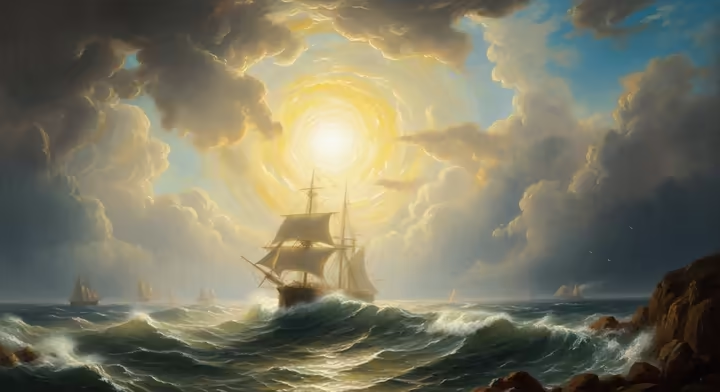
- The Quiet Glow of American Luminism: In mid-19th-century America, a group of painters developed a style that was the quiet counterpart to Turner's drama. Known as Luminism , it is characterized by tranquil, silent landscapes bathed in a pervasive, glowing light. Artists like Fitz Henry Lane and Martin Johnson Heade meticulously concealed their brushstrokes to create a smooth, polished surface (Novak 1980). Their paintings often feature calm, reflective water and hazy, atmospheric skies, evoking a sense of timeless peace and a transcendental connection with nature. 22
Impressionism & Post-Impressionism: The Science of Seeing
The late 19th century brought another major shift, driven by scientific discoveries about optics and color. The Impressionists wanted to paint the act of seeing itself.
How did Impressionists paint light so differently?
The Impressionists changed painting with a few key innovations. First, they left the studio to paint en plein air (in the open air) to capture the immediate effects of natural daylight. 24 Second, they observed that shadows are not simply black or gray but are filled with reflected light and complementary colors. A yellow, sunlit wall might cast a violet-tinged shadow. 25 Third, they used pure, vibrant colors, often applied with short, visible brushstrokes. They relied on a principle called optical mixing , where they placed dabs of different colors next to each other, allowing the viewer's eye to blend them from a distance. This creates a more shimmering and vibrant effect than colors mixed on a palette. 26
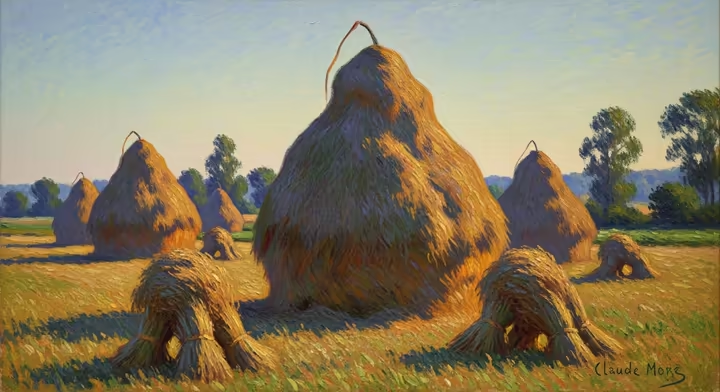
- Claude Monet's Obsession with Fleeting Moments: No artist pursued this new science of seeing more relentlessly than Claude Monet (1840-1926). His Haystacks series is the definitive Impressionist experiment. He painted the same subject repeatedly at different times of day, in different seasons, and in all kinds of weather. 28 The series proves that his true subject was not the haystack itself, but the way light and atmosphere constantly transformed its appearance. For Monet, the object was secondary; the sensation of light was everything. 28
- Vincent van Gogh's Expressive Light: Vincent van Gogh (1853-1890) took the bright colors and visible brushwork of the Impressionists and infused them with intense emotion. His light is both observed, and deeply felt. In The Starry Night , the light does not behave realistically. The stars, moon, and nebulae pulse and radiate with a living, swirling energy. 30 Van Gogh used light and color as a symbolic language to express his powerful inner vision and psychological state, a key characteristic of Post-Impressionism. 30
Modern & Contemporary Art: Light as the Medium
In the 20th and 21st centuries, light evolved from a subject depicted on canvas to the artistic medium itself. Many artists began creating works using physical light sources.
-
The Light and Space Movement:
In the 1960s and 70s, a group of artists in Southern California began using modern industrial materials to explore perception.
Dan Flavin
(1933-1996) used commercially available fluorescent light tubes to create "situations" that bathed entire rooms in colored light, redefining the architectural space.
32
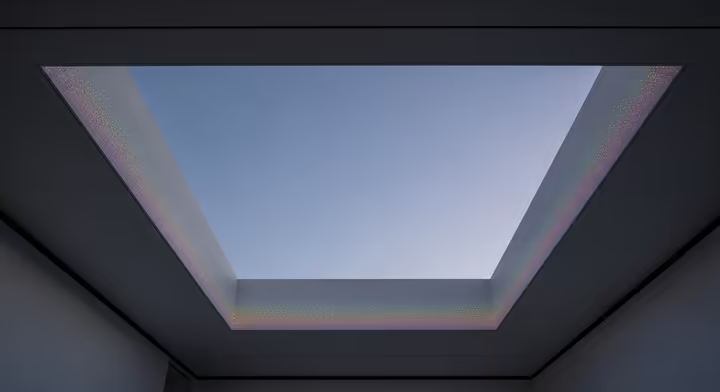
James Turrell (b. 1943) creates immersive installations that use projected or contained light to create illusions of solid forms or infinite space. In his Skyspaces and Ganzfelds , he manipulates light to create perceptual experiences, making the viewer acutely aware of their own act of seeing. 34 The experience of light becomes the artwork.
- Olafur Eliasson (b. 1967): Contemporary artist Olafur Eliasson continues this tradition with large-scale installations that use natural phenomena, light, water, mist, temperature, to create shared sensory experiences. His 2003 work, The Weather Project , filled the Turbine Hall of London's Tate Modern with a giant artificial sun and a fine mist. 36 Visitors would lie on the floor, seeing themselves as tiny silhouettes against the glowing orb in a mirrored ceiling. The work made them conscious of their environment, their perception, and their relationship to nature in an urban space. 38
- Digital Light: Painting with Pixels in the 21st Century: Today, digital artists working in fields like concept art and animation use powerful software to "paint with light" in virtual spaces. They use tools that mimic real-world physics, such as point lights, area lights, and directional lights, to craft complex and believable lighting scenarios that tell stories and build immersive worlds. 40
3. The Science and Principles of Light for the Artist
Understanding a few basic scientific principles will improve your ability to draw and paint light convincingly.
A Quick Physics Lesson for Artists
Light travels in straight lines, or rays, from its source. 42 When these rays hit an object, they either reflect (bounce off), refract (bend through), or get absorbed. 43 For an artist, the most important distinction is between two types of light in a scene:
- Direct Light: This is the light that comes straight from a primary source, like the sun, a window, or a lamp. It's the strongest light in a scene and is responsible for creating the brightest highlights and the darkest cast shadows.
- Ambient Light (or Reflected Light): This is the indirect light that fills the rest of the environment. It's made up of light rays that have bounced off the walls, the ceiling, the ground, and every other object in the scene. 42 Ambient light is much weaker than direct light, but it's important because it illuminates the shadows, preventing them from being pure black and giving them color and detail.
The Anatomy of Light and Shadow
When a single light source hits a simple object, like a sphere, it creates a predictable pattern of light and shadow. Learning to identify these parts is the first step to creating believable form. Let's break down this "anatomy". 1
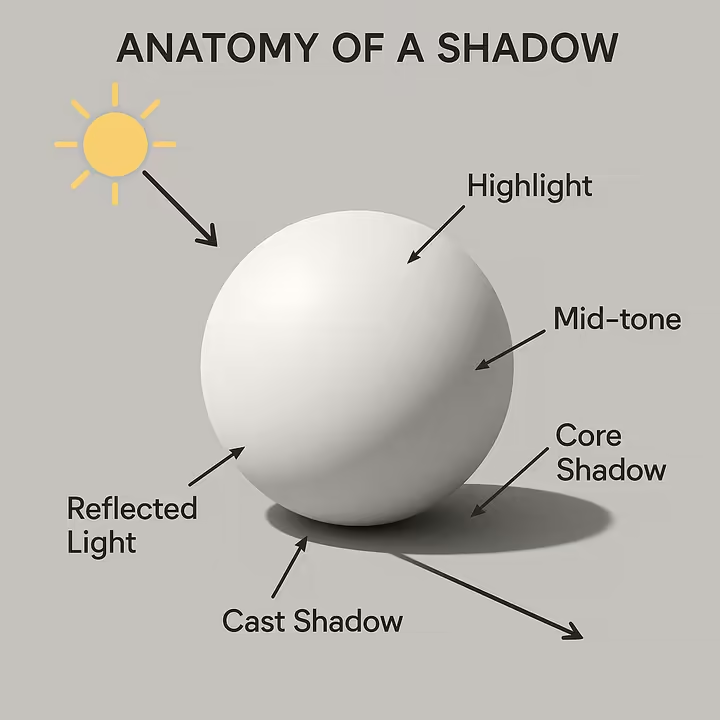
- Highlight: This is the brightest spot on the object. It's the point where the surface is angled to reflect the light source directly into your eyes.
- Mid-tone (Halftone): This is the large area on the object that is directly illuminated but is not as bright as the highlight. The surface here is curving away from the light source. The mid-tone is often where you can most clearly see the object's true color.
- Core Shadow (Terminator): This is the darkest part of the shadow on the object itself . It occurs on the part of the form that is turning away from the light, just before the point where the light can no longer reach.
- Reflected Light: This is essential for creating realistic shadows. It's a faint light that bounces off nearby surfaces (like the tabletop the sphere is sitting on) and illuminates the shadow side of the object. It is always darker than the mid-tone.
- Cast Shadow: This is the shadow that the object projects onto the surrounding surfaces. It's created because the object is blocking the direct light. The cast shadow is darkest and has the sharpest edge right next to the object, and it becomes progressively lighter and softer as it gets farther away.
What are the basic rules of light and shadow?
To create realistic lighting, keep these fundamental rules in mind:
- Light travels in straight lines. This helps you predict where shadows will fall.
- Shadows are cast on the side of an object opposite the light source.
- An object will have one cast shadow for each light source.
- The most important rule for value relationships is this: The lightest value in the shadow family (the reflected light) is always darker than the darkest value in the light family (the darkest mid-tone). 46 Separating your values into these two distinct "light" and "shadow" groups is necessary to create a convincing illusion of form and to prevent drawings from looking flat.
How Light Creates Color
Light and color are inextricably linked. The colors we see are a direct result of the light that illuminates them.
Local Color vs. Perceived Color
This is an important concept for beginners.
- Local Color is an object's inherent, "true" color under neutral, diffused light. We know that a banana is yellow, an apple is red, and grass is green. 48
- Perceived Color is the color our eyes actually see in a specific environment. This color is dramatically affected by the light source's color and temperature, reflections from other nearby objects, and atmospheric conditions. 50 An artist's job is to learn to paint the perceived color, not the local color they know in their head. That "red" apple might actually have patches of orange, pink, violet, and even blue in its perceived colors.
What is the difference between warm and cool light?
Light has a color temperature , which we perceive as either warm or cool. 52 Sunlight at noon is relatively neutral or cool (bluish). Light from a tungsten bulb or a sunset is very warm (yellowish/orange). The color temperature of your light source will affect every color in your scene.
A powerful rule to remember is: Warm light creates cool shadows, and cool light creates warm shadows. This is because shadows are primarily illuminated by ambient light. In an outdoor scene lit by warm, yellow sunlight, the main ambient light source is the blue sky. Therefore, the shadows will be filled with cool, bluish light. 52
How Light Intensity Changes Color
The intensity of light also affects a color's saturation (its purity or vibrancy).
- In very bright, intense light, colors can appear washed out and less saturated.
- In very low light, colors also become desaturated and harder to distinguish, appearing grayer or darker.
- The most saturated, vibrant colors are often found in the mid-tone areas, where the object is well-lit but not blasted by a direct highlight. 53
The Value Scale for Creating Depth
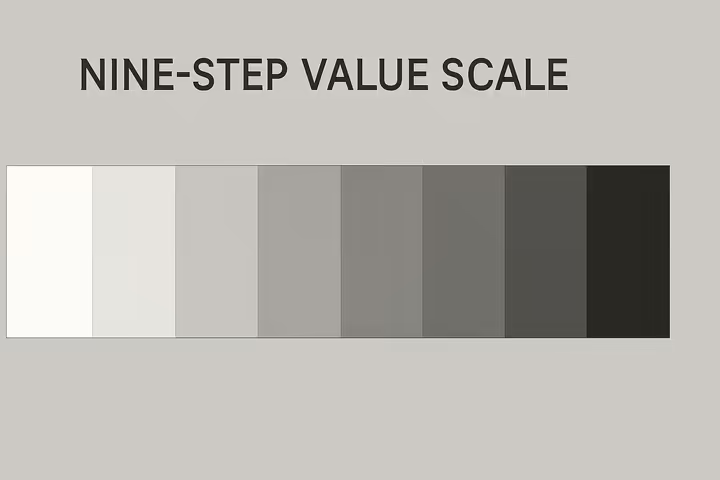
A value scale is a chart that shows a range of values from white to black, typically in 5, 7, or 9 steps. 56 Practicing it trains your eye to see value separately from color. 4 When you can accurately identify and replicate values, you can create the illusion of light, form, and depth. 2
4. Essential Techniques for Depicting Light
When you're working with a pencil, pen, or charcoal, you create the illusion of value by making marks on the paper.
Drawing and Shading Fundamentals
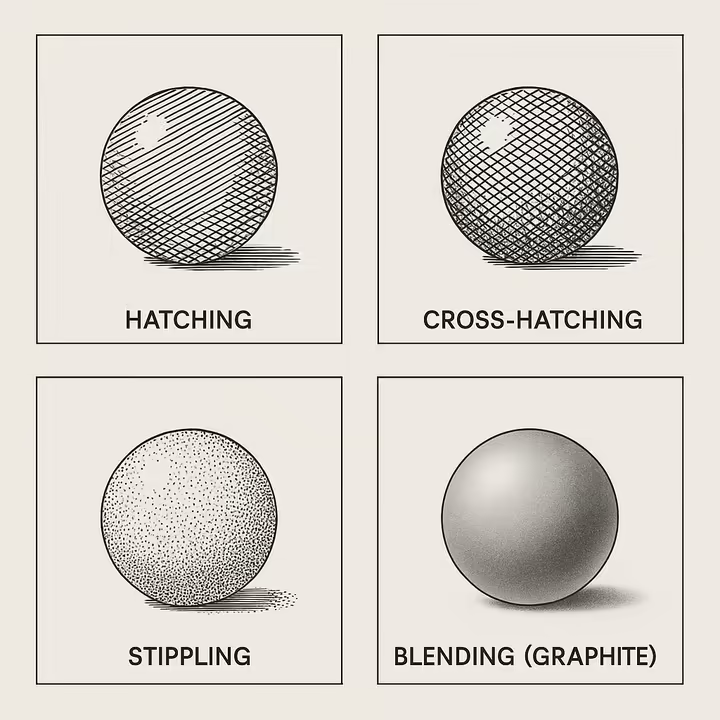
Here are four basic techniques 1 :
- Hatching: Creating value by drawing a series of parallel lines. The closer together you draw the lines, the darker the value will appear.
- Cross-Hatching: Layering sets of parallel lines over each other at different angles. This is a great way to build up very dark, rich values.
- Stippling: Creating value using only dots. The denser the concentration of dots, the darker the area. Stippling is time-consuming but creates very subtle, soft transitions.
- Blending: Physically smoothing the drawing medium (like graphite or charcoal) on the paper to create a soft, seamless gradation of value. You can use your finger, a paper stump (called a tortillon), or a cloth.
Painting with Light: Glazing
Oil painters have a special technique for creating luminosity and depth of color: glazing . A glaze is a very thin, transparent layer of paint applied over a layer of dry, opaque paint. 59
Light travels through the transparent glaze layer, hits the opaque underpainting, and reflects back to the viewer's eye, passing through the glaze a second time. This creates a rich, jewel-like color that appears to glow from within. It's a slow, layered process, but it produces effects that are impossible to achieve by simply mixing opaque paints on a palette. 59
Tips for Painting Outdoors (En Plein Air)
Painting outdoors presents a unique challenge: the sun is constantly moving. Here are a few essential tips for en plein air painting, gathered from experienced artists 24 :
- Simplify Your Scene: Don't try to paint every leaf on the tree. Squint your eyes to blur the details and see the landscape as large, simple shapes of light and shadow.
- Work Fast: You only have a limited window before the light and shadows change dramatically. Start by quickly blocking in your biggest shapes and darkest values to establish the overall light effect.
- Control Your Lighting: Never paint with your canvas or palette in direct sunlight. The glare will cause you to misjudge your colors and values, and your painting will look too dark when you bring it indoors. Find a shady spot or use an umbrella to keep your setup in consistent, even light.
- Values First, Color Second: A painting with correct values but wrong colors will still look believable. A painting with correct colors but wrong values will always look flat. Focus on getting the light and dark relationships right first.
A Beginner's Look at Digital Lighting
Digital artists have a powerful and flexible toolkit for manipulating light. In software like Adobe Photoshop or Procreate, artists often work in layers. They might start with a base color on one layer, then add shadows on a new layer above it using a "Multiply" blend mode , which darkens the colors below it. For highlights, they might use another layer set to a "Screen" or "Overlay" blend mode, which lightens the colors below. This non-destructive workflow allows for extensive experimentation with different lighting schemes. 61
5. Practical Exercises & Common Mistakes
Here are a few foundational exercises to help you practice seeing and depicting light, along with some common mistakes to avoid.
Putting Theory into Practice: Beginner Exercises
What are some good light source exercises for beginners?
These exercises are designed to build your observational skills from the ground up.
-
Observational Study: The Foundational Sphere
This is a foundational exercise for any beginner. It teaches you the complete "Anatomy of Shadow" in a controlled setting. 3
- Set Up: Find a simple, matte-white object like an egg, a ping-pong ball, or a plaster sphere. Place it on a neutral surface (like a gray piece of paper).
- Light It: In a darkened room, set up a single, strong light source, like a desk lamp, pointed at the object from one side.
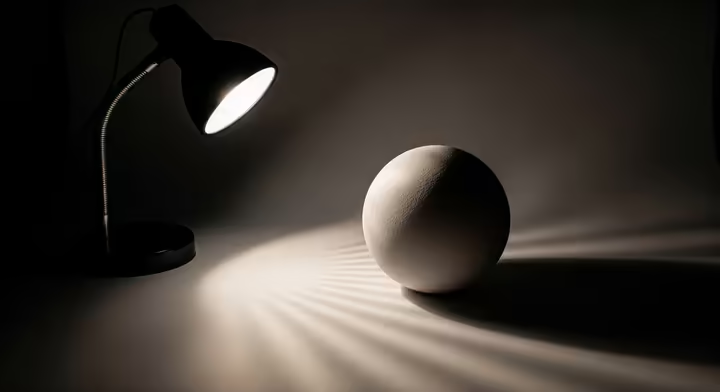
- Observe: Carefully look at the object. Identify all the parts of the light and shadow: the highlight, mid-tone, core shadow, reflected light, and cast shadow.
- Draw: Using a pencil, try to accurately draw what you see. Focus on the shapes of the values, not on drawing an outline of the egg.
- Experiment: Move the lamp to different positions, higher, lower, more to the front, and do a new drawing each time. Notice how the size, shape, and placement of the shadows change. 65
-
Value Scale Practice
This exercise trains your hand and eye to create a consistent range of values. 56
- Create a Grid: Draw a long rectangle and divide it into nine equal squares.
- Establish Extremes: Leave the first square pure white (the paper). Fill the last square with your darkest black (using a soft pencil like a 6B).
- Find the Middle: In the fifth square (the middle one), try to create a gray that looks exactly halfway between your white and black.
- Fill the Gaps: Now, carefully fill in the remaining squares, creating a smooth, even transition from light to dark. Constantly compare each square to its neighbors.
-
Time of Day Study
This exercise takes your skills outdoors and forces you to observe how natural light changes. 64
- Choose a Subject: Pick a simple, stationary subject outside your window, like a tree, a mailbox, or the corner of a building.
- Draw it Three Times: Do a quick sketch or painting of your subject at three different times: once in the early morning, once around noon, and once in the late afternoon.
- Analyze the Changes: Compare your three studies. How did the length and direction of the cast shadows change? How did the color of the light shift from cool morning light to warm afternoon light? This exercise powerfully demonstrates that light is dynamic, not static.
Common Mistakes to Avoid
Every beginner makes these mistakes. Recognizing them is the first step to fixing them.
How do I create realistic shadows?
You can create realistic shadows by understanding and avoiding these common pitfalls:
-
Mistake 1: "Timid" Shading and Flat Values
- The Problem: Beginners are often afraid of making things too dark. They use a very narrow range of values, resulting in a drawing that looks pale, washed out, and flat. 46
- The Fix: Be bold. Don't be afraid to use your darkest darks. A full range of value, from bright white to rich black, creates high contrast and makes a drawing appear more three-dimensional.
-
Mistake 2: Reflected Light is Too Bright
- The Problem: A beginner sees the reflected light in a shadow and makes it almost as bright as a highlight. This destroys the illusion of form because it makes the shadow side of the object appear to be in the light. 46
- The Fix: Remember this rule: "The lightest dark is always darker than the darkest light." Reflected light is part of the shadow family. It must remain a darker value than any of your mid-tones.
-
Mistake 3: Relying on Outlines
- The Problem: Beginners often draw a hard contour around an object and then "color it in." Real-world objects don't have black lines around them. 66
- The Fix: Learn to see in shapes of value, not lines. Instead of drawing the outline of a nose, try to see the shape of the highlight on the bridge, the shape of the shadow on the side, and the shape of the cast shadow from the nostril. Let the edges where these value shapes meet define the form of the nose.
-
Mistake 4: Neglecting Cast Shadows
- The Problem: The cast shadow is often treated as an afterthought, or forgotten entirely. This makes the object look like it's floating in space instead of sitting firmly on a surface. 3
- The Fix: Treat the cast shadow as an essential shape in your composition. It helps to anchor your subject, define the surface it's on, and give crucial information about the direction and intensity of your light source.
Mastering light is a long-term process that improves artistic skill and enhances one's perception of the world. Every shadow, reflection, and glint of light becomes a source of information. Be patient, be observant, and continue to explore the effects of light.
Works cited
- Mastering Light and Shadow , A Guide to Essential Techniques for ..., https://medium.com/@inspirationgems/mastering-light-and-shadow-a-guide-to-essential-techniques-for-artists-25c1ea0ee76b
- 4.1 – Introduction to Value – Vitruvian Fine Art Studio, https://vitruvianstudio.com/lesson/4-1-introduction-value/
- Beginner's Guide to Light and Shadow for Artists - Draw Paint ..., https://drawpaintacademy.com/light-and-shadow/
- The Elements of Art - "Value" - The Virtual Instructor, https://thevirtualinstructor.com/Value.html
- Light and Colour in Medieval Christianity – Introducing Medieval ..., https://introducingmedievalchristianity.wordpress.com/2019/05/09/light-and-colour-in-medieval-christianity/
- blogs.loc.gov, https://blogs.loc.gov/picturethis/2018/12/renaissance-and-baroque-color-researching-chiaroscuro-woodcuts-at-the-library-of-congress/#:~:text=Although%20the%20chiaroscuro%20technique%20was,light%20and%20scuro%20for%20shade.
- How Sfumato Changed Art Forever: Explore Leonardo da Vinci's Master Technique, https://www.jerrypoon.com/post/mastering-sfumato-leonardo-da-vinci-technique
- Sfumato - Wikipedia, https://it.wikipedia.org/wiki/Sfumato
- Caravaggio and Tenebrism, Beauty of Light and Shadow in Baroque Paintings - SciSpace, https://scispace.com/pdf/caravaggio-and-tenebrism-beauty-of-light-and-shadow-in-3i4djg6yp9.pdf
- en.wikipedia.org, https://en.wikipedia.org/wiki/Tenebrism#:~:text=The%20technique%20was%20developed%20to,the%20illusion%20of%20three%2Ddimensionality.
- Artemisia Gentileschi: Baroque Mastery and Feminist Icon, https://artsartistsartwork.com/artemisia-gentileschi-baroque-mastery-and-feminist-icon/
- Shadow and Light: Baroque Era Painting - IDEAS - WordPress.com, https://blarse.wordpress.com/2015/02/23/shadow-and-light-judith-and-holofernes/
- Judith Slaying Holofernes (Artemisia Gentileschi, Naples) - Wikipedia, https://en.wikipedia.org/wiki/Judith_Slaying_Holofernes_(Artemisia_Gentileschi,_Naples)
- Georges de La Tour: Master of Candlelight, Mystery, and Spiritual Realism in Baroque Art, https://artlearnings.com/2024/03/13/georges-de-la-tour-master-of-candlelight-in-baroque-art/
- Georges de La Tour | The Penitent Magdalen | The Metropolitan ..., https://www.metmuseum.org/art/collection/search/436839
- Rembrandt van Rijn: Master of Light and Shadow , EMP_Art, https://www.emp-art.com/emp-blog/rembrandt-van-rijn-master-of-light-and-shadow
- Rembrandt: Master of Light and Shadow - Number Analytics, https://www.numberanalytics.com/blog/rembrandt-ultimate-guide
- Painting light: Vermeer's technique transformed reality , Google ..., https://artsandculture.google.com/story/painting-light-vermeer-s-technique-transformed-reality/2gWRJnG3nXaoJQ?hl=en
- 5 Unbelievable Facts About Vermeer's Use of Light, https://perfectpicturelights.com/blog/vermeers-use-of-light
- Turner. Light is colour | Museu Nacional d'Art de Catalunya, https://www.museunacional.cat/en/turner-light-colour
- J.M.W. Turner's Brilliant Seascapes - 1st Art Gallery, https://www.1st-art-gallery.com/article/the-atmospheric-seascapes-of-jmw-turner/
- Luminism (American art style) - Wikipedia, https://en.wikipedia.org/wiki/Luminism_(American_art_style)
- American Luminism - Howard Bosler Artist, https://howardbosler.com/2020/12/08/american-luminism/
- Plein Air Painting for Dummies - OutdoorPainter, https://www.outdoorpainter.com/plein-air-for-beginners/
- The anatomy of a shadow - Cedar Lane Studio | art & design, http://www.cedarlanestudio.net/blog/the-anatomy-of-a-shadow
- www.malcolmdeweyfineart.com, https://www.malcolmdeweyfineart.com/blog/the-impressionists-palette-capturing-true-light-with-color#:~:text=This%20theory%20argues%20that%20colors,luminous%20effects%20in%20their%20paintings.
- The Impressionists' Palette: Capturing True Light with Color ..., https://www.malcolmdeweyfineart.com/blog/the-impressionists-palette-capturing-true-light-with-color
- Haystacks, by Claude Monet, https://www.claude-monet.com/haystacks.jsp
- The Allure of the Haystacks Paintings by Claude Monet - Artsper Magazine, https://blog.artsper.com/en/a-closer-look/claude-monet-haystacks-paintings/
- Vincent van Gogh. The Starry Night. Saint Rémy, June 1889 | MoMA, https://www.moma.org/collection/works/79802
- Mood and Light, Movement and Line Although Van Gogh's painting career was relatively short, he painted over 900 paintings over - Blumenthal Arts, https://www.blumenthalarts.org/assets/doc/Teen_AdultArtElements-FINAL-33f27c9a5f.pdf
- Dan Flavin | Untitled - The Metropolitan Museum of Art, https://www.metmuseum.org/art/collection/search/904835
- Dan Flavin - Artworks & Biography | David Zwirner, https://www.davidzwirner.com/artists/dan-flavin
- James Turrell | Pace Gallery, https://www.pacegallery.com/artists/james-turrell/
- Light and Space Movement Overview | TheArtStory, https://www.theartstory.org/movement/light-and-space/
- OLAFUR ELIASSON : The Weather Project - YouTube, https://www.youtube.com/watch?v=kYAaZ53tazU
- Olafur Eliasson - Wikipedia, https://en.wikipedia.org/wiki/Olafur_Eliasson
- Exploring The Weather Project by Olafur Eliasson - Singulart, https://www.singulart.com/blog/en/2024/01/02/the-weather-project-by-olafur-eliasson/
- Olafur Eliasson's The Weather Project - Confluence, https://confluence.gallatin.nyu.edu/context/interdisciplinary-seminar/olafur-eliassons-the-weather-project
- 3D Lighting: Techniques, Applications, and Career Paths in Digital Art, https://cada-edu.com/guides/3d-lighting
- Level Design Workshop: Blockmesh and Lighting Tips - YouTube, https://www.youtube.com/watch?v=09r1B9cVEQY
- Light and Shadow in Art - The Fundamentals of Light, Part 1: The Science & The Basics Made Clear (2025) - CecelyV, https://cecelyv.com/light-and-shadow-in-art/
- www.mattgablerart.com, https://www.mattgablerart.com/post/the-physics-of-light-how-artists-manipulate-light-and-shadow#:~:text=The%20physics%20of%20light%20is,and%20shadow%20in%20their%20work.
- A Beginners Guide to Light & Shadow - Part 1 - Will Kemp Art School, https://willkempartschool.com/a-beginners-guide-to-shadow-light-part-1-drawing/
- Guide to Drawing Shadows | Art Rocket, https://www.clipstudio.net/how-to-draw/archives/163236
- Top 5 Shading Mistakes - Proko, https://www.proko.com/lesson/top-5-shading-mistakes/notes
- How do people know where to put shadows when shading? I can't ..., https://www.reddit.com/r/learnart/comments/199rf2o/how_do_people_know_where_to_put_shadows_when/
- Mastering Local Color in Art - Number Analytics, https://www.numberanalytics.com/blog/ultimate-guide-local-color
- Local Color vs Perceived Color in Art - Watercolor Affair, https://www.watercoloraffair.com/local-color-vs-perceived-color-in-art/
- www.watercoloraffair.com, https://www.watercoloraffair.com/local-color-vs-perceived-color-in-art/#:~:text=The%20local%20color%20is%20the,appear%20under%20different%20lighting%20situations.
- Local Color Vs. Perceived Color - YouTube, https://www.youtube.com/watch?v=1MEM1EKhR6o
- Understanding Color: Temperature , Charlene Collins Freeman Art, https://charlenecollinsfreeman.com/blog-montauk/2018/11/28/understanding-color-temperature
- Understanding Color: Intensity - Charlene Collins Freeman Art, https://charlenecollinsfreeman.com/blog-montauk/2018/12/12/understanding-color-intensity
- Mastering Saturation in Art - Number Analytics, https://www.numberanalytics.com/blog/ultimate-guide-to-saturation-in-drawing-and-painting
- Saturation's Luminosity does not Equal Value - Master Oil Painting, https://www.masteroilpainting.com/saturations-luminosity-does-not-equal-value/
- How to Draw a Value Scale (Step by Step Tutorial), https://www.thedrawingsource.com/value-scale.html
- Drawing Lesson - A Theory of Light and Shade, https://www.artinstructionblog.com/drawing-lesson-a-theory-of-light-and-shade
- Hatching and cross-hatching | Drawing I Class Notes | Fiveable ..., https://library.fiveable.me/drawing-foundations/unit-6/hatching-cross-hatching/study-guide/SBjr8djW1TCdGeXY
- www.chuckblackart.com, https://www.chuckblackart.com/blogs/the-painters-block/how-glazing-can-improve-your-oil-painting#:~:text=A%20glaze%20can%20be%20achieved,layers%2C%20creating%20a%20luminous%20effect.
- How Glazing Can Improve Your Oil Painting – Chuck Black Art, https://www.chuckblackart.com/blogs/the-painters-block/how-glazing-can-improve-your-oil-painting
- 8 Digital Art Lighting Tutorials for Mastering Lighting - Cubebrush, https://cubebrush.co/blog/8-digital-art-lighting-tutorials-for-mastering-lighting
- Easy tips to paint light and shadow | Art Rocket - CLIP STUDIO PAINT, https://www.clipstudio.net/how-to-draw/archives/165400
- Anyone have exercise recommendations for understanding light ..., https://www.reddit.com/r/learntodraw/comments/1b86dw1/anyone_have_exercise_recommendations_for/
- How can i practice light and shadow? : r/ArtistLounge - Reddit, https://www.reddit.com/r/ArtistLounge/comments/s9fy15/how_can_i_practice_light_and_shadow/
- www.reddit.com, https://www.reddit.com/r/ArtistLounge/comments/1bn36j1/does_anyone_know_any_good_lighting_exercises/#:~:text=Set%20up%20a%20still%20life,then%20set%20up%20another%20one.
- Artists of Reddit, what are some common mistakes people make ..., https://www.reddit.com/r/AskReddit/comments/8tbr3x/artists_of_reddit_what_are_some_common_mistakes/