The Artist's Gaze: A Comprehensive Guide to the Focal Point
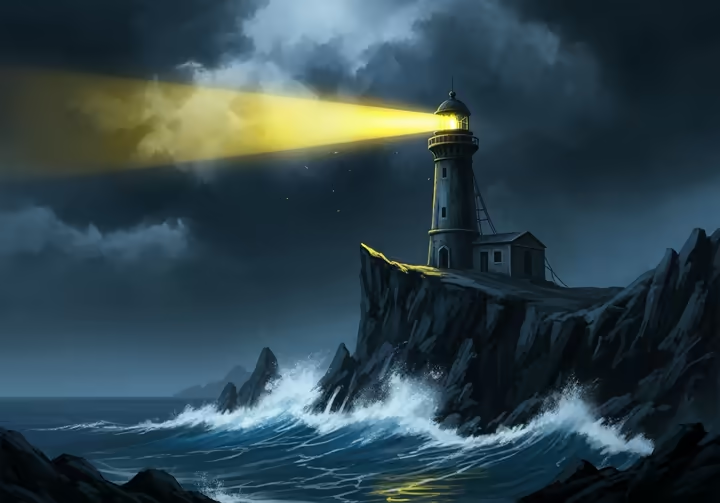
Ever look at a painting and your eyes go straight to one spot? That's not an accident, that's a focal point! It's the artist's way of saying "Hey, look here!" and it's one of the coolest tricks in the book.
What's a Focal Point, Anyway?
Your Visual Anchor
A focal point is just the most interesting bit of a picture. It’s the part that grabs your attention first, before your eyes start wandering around the rest of the piece. Think of it as an anchor, without it, a composition can feel messy and chaotic.
Artists do this on purpose. They create a visual hierarchy, a fancy way of saying they make one part of the artwork more important than the others. This tells you where the story starts.
Why Our Brains Fall for It
These aren't just stuffy art rules, they're tricks based on how our brains work. Our eyes are hardwired to notice the area with the greatest contrast, where light and dark smash together. An artist who puts a bright highlight against a dark shadow is using our own biology to make us look.
On top of that, our brains are obsessed with finding patterns, especially human faces. You can have a whole landscape, but if there's a tiny person in it, that's where we'll look first. Artists use this "hack" to guide our attention exactly where they want it.
The Artist's Toolkit
To create a focal point, artists have a whole bag of tricks. They often mix and match a few of them to make something really powerful. Some are obvious, some are sneaky. A good artist knows which tool to use for the job.
The Power of Contrast
Want to make something stand out? Use contrast. It's your best friend for getting attention because our eyes are built to seek out what's different.
Value Contrast (Light vs. Dark)
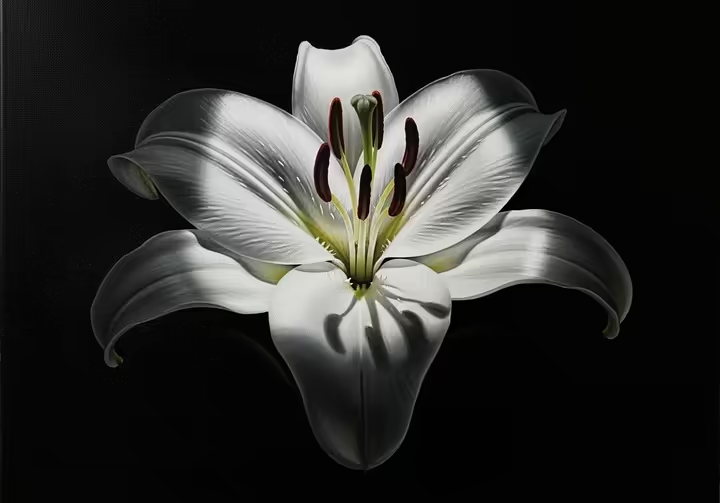
Value, the lightness or darkness of a color, is the big one. Our eyes spot changes in value before anything else, making it the most powerful way to create a focal point. Put your brightest bright right next to your darkest dark, and you've got an instant magnet for the eyes.
Color Contrast
Color gives you a few fun ways to create contrast. A splash of a bright, pure color in a field of dull, muted tones will pop immediately. Think of a single red flower in a gray-green field, you can't help but look there first.

You can also use temperature. Placing a warm color (like red or yellow) against a cool one (like blue or green) creates a strong visual pull. Warm colors feel like they're coming toward you, while cool colors feel like they're moving away.
Shape and Size Contrast
Our brains love patterns, and they really notice when a pattern is broken. A single sharp, boxy shape in a picture full of soft, curvy shapes will stand out. The same goes for size, a huge object among tiny ones (or vice-versa) will always get noticed.
Textural Contrast
An artist can also create a focal point by using texture. Imagine a painting of rough tree bark and stone, but with a small patch of smooth, glassy water. The contrast in texture draws your eye right to it.
Detail Contrast
Our eyes are hungry for information. An area of a painting with tons of sharp, crisp detail will get more attention than blurry or simple areas. This mimics how our own eyes work, we see one thing in focus while everything else is a bit fuzzy.
Where You Put It
It's not just what you show, but where you put it. You can make even a simple object important just by placing it in the right spot.
The Rule of Thirds
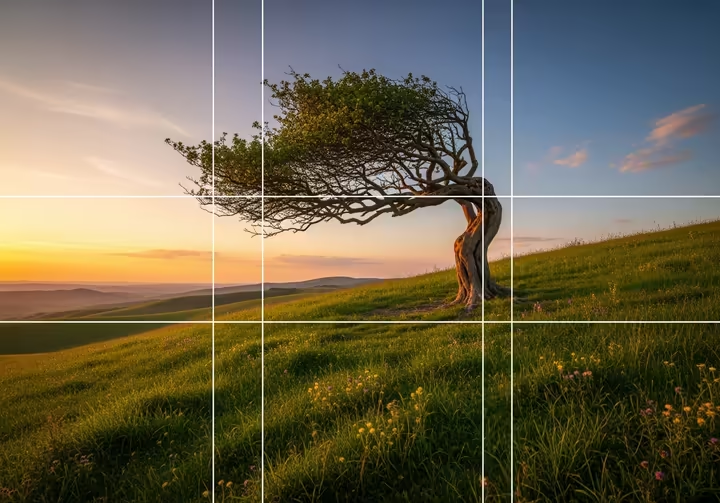
This is a classic. Imagine cutting your picture into a tic-tac-toe grid. The Rule of Thirds says that putting your main subject on one of the lines, or especially where the lines cross, makes for a better-looking picture. Those four crossing points are like natural eye-magnets.
Central Placement
Of course, you can just stick your subject right in the middle. This creates a more formal, static, and sometimes confrontational feeling. It locks the viewer's gaze and is great for portraits or any subject you want someone to really stare at.
Isolation and Negative Space
One of the easiest ways to make something important is to give it room to breathe. By placing a subject by itself, surrounded by "negative space" (the empty area around it), you make it the star of the show. This can also create a mood, like loneliness, peace, or vulnerability.
Guiding the Eye
The best artists don't just hope you find the focal point. They build roads and signposts to lead you right to it.
Leading Lines
Leading lines are paths for your eye to follow. They can be obvious things like roads, fences, or rivers. They can also be sneaky, like a row of trees, a shadow, or the way a bunch of objects are arranged.
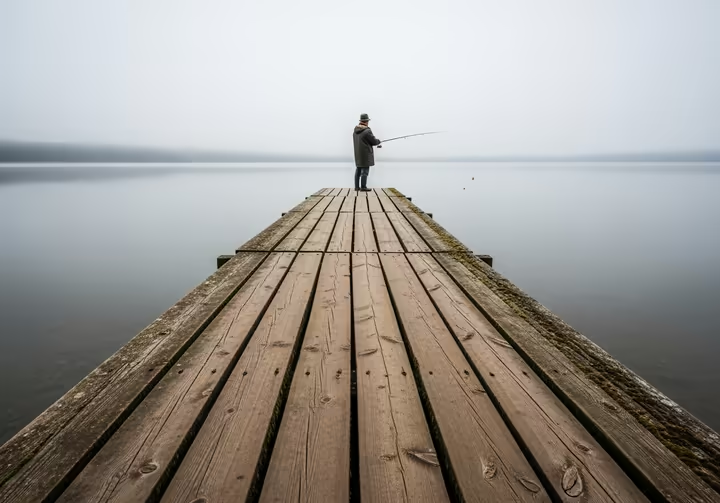
Different lines have different vibes. Horizontal lines feel calm, vertical lines feel strong, and diagonal lines create energy and movement. Curved lines feel natural and graceful.
Convergence
This is when lines in a picture all seem to head toward a single point in the distance, like train tracks disappearing at the horizon. It's a super-strong trick that creates a ton of depth. It acts like a visual funnel, forcing your attention to that one spot.
Gaze and Gesture (Implied Lines)
Some of the most powerful lines aren't really lines at all. If a person in a painting is looking at something, we have an overwhelming urge to look at it too. A pointing finger or an outstretched arm works the same way, telling our eyes exactly where to go.
Fun with Focus and Surprises
Selective Focus and Edges
You've seen this in photos all the time. The main subject is sharp and crisp, while the background is all soft and blurry. This both mimics how our eyes see and clearly tells us what's important. Hard, sharp edges demand focus, while soft edges fade into the background.
Anomaly (The "Odd One Out")
Our brains are wired to notice weird stuff. An artist can create a focal point by sticking something in that doesn't belong. A single dead flower in a perfect bouquet or a bright pink door on a gray building will immediately grab our attention because it's a surprise.
| Technique | Description | Intended Effect |
|---|---|---|
| Value Contrast | Puts the lightest light next to the darkest dark. | Instantly grabs attention. Your most powerful tool. |
| Color Contrast | Uses bright vs. dull colors, or warm vs. cool. | Makes a spot pop and can create a mood. |
| Isolation | Separates the subject from everything else. | Makes the subject feel important, peaceful, or lonely. |
| Placement | Puts the subject on a Rule of Thirds point or dead center. | Feels either natural and balanced or formal and intense. |
| Leading Lines | Uses lines, real or implied, to point to the subject. | Creates a path that leads the viewer's eye right where you want it. |
| Convergence | Makes multiple lines meet at or near the subject. | Creates a powerful sense of depth, funneling attention to one spot. |
| Anomaly | Includes something weird or out of place. | Surprises the viewer and makes the "odd one out" the star. |
| Selective Focus | Keeps the subject sharp while blurring the background. | Mimics real vision and clearly separates the subject from its surroundings. |
Seeing It in Action
Theory is great and all, but let's see how the pros did it. Looking at famous artworks shows you how these tricks are used to tell a story or create a feeling.
Leonardo da Vinci, The Last Supper (c. 1495-1498)
Leo had a big problem: how do you paint thirteen guys at a long table and make it interesting? His solution was genius. He put Jesus right in the geometric center, a clear statement of his importance. Then, he made every single architectural line in the room, the ceiling, the walls, point directly at Christ’s head.
This creates an irresistible visual funnel, you literally can't look anywhere else. He also isolated Christ in a calm space, framed by a window that acts like a natural halo. Everyone else is in chaotic, noisy groups, which makes Christ’s stillness even more powerful.

Caravaggio, The Calling of St. Matthew (c. 1599-1600)
This guy loved drama. In this painting, he uses a killer beam of light that slices through a dark tavern. The light acts like a big pointing arrow, hitting Christ's pointing hand and then landing squarely on Matthew, the tax collector.
That intense contrast of light and dark, called tenebrism , is Caravaggio's signature move. The focal point is really the conversation between two hands: Christ's, who is calling, and Matthew's, who points to himself as if to say, "Who, me?". It’s a whole story told in a single beam of light.
Edgar Degas, L'Absinthe (1876)
Degas shows how a focal point can be about a feeling, in this case, the loneliness of city life. He breaks the rules by shoving the two figures off to the side, creating a wonderfully awkward composition. The woman is the clear focal point, not because of lighting, but because of her emotional weight.
Her slumped posture and empty stare draw us into her sad, disconnected world. Even though she's sitting next to a man, the space between them feels huge. Degas uses the diagonal lines of the tables to box them in, reinforcing their trapped, lonely feeling.
Steve McCurry, Afghan Girl (1984)
In photography, a focal point often creates a direct human connection. And boy, does this photo deliver. The girl's piercing green eyes are the electrifying focal point. McCurry cleverly uses color contrast, the bright red of her scarf makes her green eyes pop like you wouldn't believe.
Then there’s her direct, challenging stare. She looks right at the viewer, creating an unforgettable connection. McCurry also uses a shallow depth of field, her face is perfectly sharp while the background is a soft blur, isolating her and making her the only thing that matters.
Breaking the Rules
Once you know the rules, you can start to bend them. Deciding to use multiple focal points, or none at all, is a big choice that can completely change how a piece of art feels.
Juggling More Than One Focal Point
You don’t have to stick to just one focal point. An artwork can have two or three, but it’s a tricky balancing act. To keep it from becoming a confusing mess, you need a clear hierarchy.
There should be one main "boss" focal point and one or two "sidekick" points. This creates a rhythm, guiding the viewer's eye on a longer journey through the picture. It’s perfect for telling a more complex story.
What if There's No Focal Point?
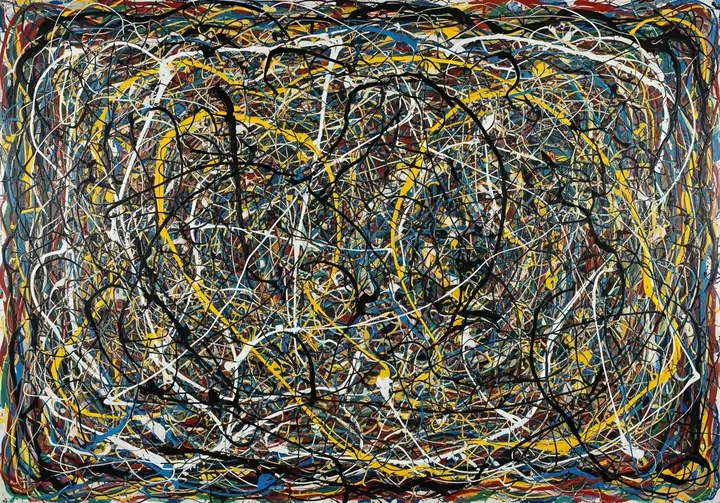
So what happens if an artist just throws the whole idea out the window? You get an "all-over composition," where the entire painting gets equal emphasis. This idea is most famous with Abstract Expressionists like Jackson Pollock.
In Pollock’s "drip" paintings, there's no single place to rest your eye. The tangled web of paint goes from edge to edge, with no part being more important than any other. The whole painting becomes the subject. Your eye is free to just roam around, which is a totally different and immersive experience.
Now, You Try It
Okay, enough theory. The fun part is putting this stuff into practice. Learning to control where people look is a huge step for any artist.
Common Mistakes (And How to Fix 'Em)
A classic beginner mistake is having no clear focal point. Every part of the picture screams for attention, which just creates visual noise and confuses the viewer. The fix is simple: plan ahead! Decide what the "star" of your piece is before you even start.
Another common issue is having too many competing focal points of equal strength. The viewer's eye bounces between them, which feels chaotic. The solution is to create a hierarchy, pick a boss and some sidekicks, and make sure the boss is the one with the most contrast and detail.
Be careful where you place your star. Sticking a focal point too close to the edge of the canvas can accidentally lead the viewer's eye right out of the picture. When in doubt, the rule of thirds is a safe and effective bet.
Exercises to Sharpen Your Eye
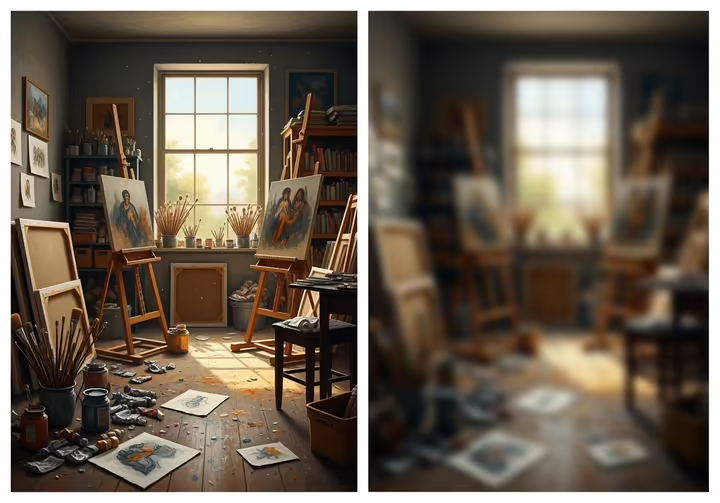
The Squint Test: This is an artist's secret weapon. Step back from your work and squint until everything becomes a blurry mess. Whatever part still pops out is your real focal point, whether you meant for it to be or not!
Thumbnail Sketches: Before starting a big piece, draw a bunch of tiny, quick versions in little boxes. This lets you experiment with different compositions and figure out the best placement for your focal point without wasting hours of work.
Copy the Masters: One of the best ways to learn is to copy the greats. Pick a painting you love and try to recreate it. The goal isn't a perfect replica, but to understand the artist's decisions, how did they lead your eye? What tricks did they use?
In the end, a focal point is the heart of your visual story. It's your first word in the conversation. By mastering these tools, you can guide not just the viewer's eye, but their thoughts and feelings, too.
Works cited
- Design Principles: Focal Point - Brigham Young University-Idaho ..., https://courses.byui.edu/art110_new/art110/week09/focal-point.html#:~:text=A%20focal%20point%20is%20the,it%20can't%20help%20it.
- Focal Point - (Intro to Art) - Vocab, Definition, Explanations | Fiveable ..., https://library.fiveable.me/key-terms/introduction-art/focal-point
- beverlyboy.com, https://beverlyboy.com/filmmaking/what-is-focal-point-in-art/#:~:text=THE%20IMPORTANCE%20OF%20A%20VISUAL%20FOCUS%20IN%20ART&text=A%20well%2Ddefined%20focal%20point,interpret%20underlying%20messages%20or%20emotions.
- Monday Morning Art School: five ways to create focal points | Carol L. Douglas, https://www.watch-me-paint.com/five-ways-to-create-focal-points/
- What is a Focal Point in Art — Composition Techniques 101 - StudioBinder, https://www.studiobinder.com/blog/what-is-a-focal-point-definition/
- Design Principles: Focal Point - Brigham Young University-Idaho ART 110, https://courses.byui.edu/art110_new/art110/week09/focal-point.html
- How do you create a focal point? : r/learnart - Reddit, https://www.reddit.com/r/learnart/comments/1esq1jk/how_do_you_create_a_focal_point/
- The role that composition plays in determining how a viewer looks at landscape art - PMC, https://pmc.ncbi.nlm.nih.gov/articles/PMC7963460/
- Focal Point | John Lovett Artist, https://www.johnlovett.com/focal-point
- Creating a Focal Point in Your Art - Michelle Gibbs Art, https://michellegibbs.co.uk/creating-a-focal-point-in-your-art/#:~:text=Value%20contrast%20involves%20using%20light,immediately%20catch%20the%20viewer's%20eye.
- 118 - 9 Different Types of Focal Points in Art - Painting Lessons With Marla, https://paintinglessonswithmarla.com/118-9-different-types-of-focal-points-in-art/
- Mastering Texture Contrast in Representational Drawing, https://www.numberanalytics.com/blog/mastering-texture-contrast-in-representational-drawing
- How to apply the rule of thirds in photography - Shorthand, https://shorthand.com/the-craft/the-rule-of-thirds-in-photography/index.html#:~:text=It%20involves%20dividing%20an%20image,these%20lines%20or%20their%20intersections.
- How to apply the rule of thirds in photography - Shorthand, https://shorthand.com/the-craft/the-rule-of-thirds-in-photography/index.html
- Isolation - (Drawing I) - Vocab, Definition, Explanations | Fiveable ..., https://library.fiveable.me/key-terms/drawing-foundations/isolation
- roblevintennis.medium.com, https://roblevintennis.medium.com/illustration-teardowns-focal-point-82eaf1745a28#:~:text=a%20nice%20motif.-,Isolation,sole%20focus%20on%20your%20subject.
- How To Use Isolation In Compositional Structure? - Drawing and Painting Academy, https://www.youtube.com/watch?v=KBjChTVsfAE
- Leading lines | Drawing I Class Notes | Fiveable | Fiveable, https://library.fiveable.me/drawing-foundations/unit-8/leading-lines/study-guide/3yMgEfRqu9EvLDSZ
- Understanding the Power of Leading Lines — Spirited Design Studio - Doreen McGunagle, https://www.doreenmcgunagle.com/blog/understanding-the-power-of-leading-lines
- How To Use Leading Lines To Create More Interesting Compositions, https://drawpaintacademy.com/how-to-use-leading-lines/
- How to use leading lines in your image compositions: 7 examples - Focus | Picfair's, https://focus.picfair.com/articles/how-to-use-leading-lines-to-enhance-your-compositions
- Mastering Leading Lines in Art - Number Analytics, https://www.numberanalytics.com/blog/leading-lines-in-drawing-fundamentals
- How to Create Focal Points in Art - YouTube, https://www.youtube.com/watch?v=bFEC9v4_TUM
- 5 WAYS to Create a Focal Point in Art (2020) - YouTube, https://www.youtube.com/watch?v=jmum9Utps_w
- Creating a Focal Point in Your Art - Michelle Gibbs Art, https://michellegibbs.co.uk/creating-a-focal-point-in-your-art/#:~:text=Leading%20Lines,the%20way%20objects%20are%20arranged.
- Mastering Focal Points in Art | Online Art Lessons, https://onlineartlessons.com/tutorial/mastering-focal-points-in-art/#:~:text=Use%20implied%20lines%20to%20direct,subtly%20lead%20the%20viewer's%20eye.
- Mastering Selective Focus in Fine Art - Number Analytics, https://www.numberanalytics.com/blog/mastering-selective-focus-in-fine-art-photography
- Photography Tips: Selective Focus - Jackie Kramer Fine Art, https://www.jackiekramerfineart.com/post/2018/04/27/photography-tips-selective-focus
- Mastering Focal Points in Art - Online Art Lessons, https://onlineartlessons.com/tutorial/mastering-focal-points-in-art/
- 7 Most Common Painting Mistakes Beginners Make (And How to Avoid Them), https://drawpaintacademy.com/common-painting-mistakes/
- Unconventional Art: Anomaly in Painting - Number Analytics, https://www.numberanalytics.com/blog/ultimate-guide-to-anomaly-in-painting
- Odd-One-Out: Anomaly Detection by Comparing with Neighbors - ResearchGate, https://www.researchgate.net/publication/381851426_Odd-One-Out_Anomaly_Detection_by_Comparing_with_Neighbors
- Analysis of the Last Supper - Last Supper Ticket, https://lastsupperticket.com/blog/analysis-of-the-last-supper/
- Last Supper | Art and Science in the Renaissance, https://artandscienceintherenaissance.wordpress.com/2013/04/01/last-supper/
- www.walksofitaly.com, https://www.walksofitaly.com/blog/art-culture/facts-about-da-vincis-last-supper#:~:text=Arguably%20the%20best%20example%20of,focal%20point%20of%20the%20painting.
- Last Supper | Painting, Milan, History, & Facts - Britannica, https://www.britannica.com/topic/Last-Supper-fresco-by-Leonardo-da-Vinci
- The Last Supper, https://galileo.org/tips/davinci/lastsupper.html
- A powerful theatrical machine - Museo del Cenacolo Vinciano, https://cenacolovinciano.org/en/story/a-powerful-theatrical-machine/
- Caravaggio, Calling of Saint Matthew - Smarthistory, https://smarthistory.org/caravaggio-calling-of-st-matthew/
- The Calling of St. Matthew - The Catholic Physicist, https://catholicphysicist.com/2017/07/10/the-calling-of-st-matthew/
- The Current Location of The Absinthe Drinker Painter, https://www.gerrymartinez.com/the-absinthe-drinker-painter/
- Degas and “L'Absinthe” - BOCCONI STUDENTS ARTS SOCIETY, https://bsartsociety.wordpress.com/2020/12/13/degas-and-labsinthe/
- Work of the week – Edgar Degas In a café (The Absinthe drinker) (Dans un café (L'absinthe)) | NGV, https://www.ngv.vic.gov.au/work-of-the-week-edgar-degas-in-a-cafe-the-absinthe-drinker-dans-un-cafe-labsinthe/
- Haunted, Yet Haunting: A Visual Analysis of "The Afghan Girl", https://commons.lib.jmu.edu/cgi/viewcontent.cgi?httpsredir=1&article=1002&context=lexia
- AFGHAN GIRL, by Steve McCurry, has morphed from doc - Southwestern Secure Online, https://people.southwestern.edu/~bednarb/vmc/articles/edwards-afghangirl.pdf
- What Is A Focal Point In Art And Do You Need One?, https://drawpaintacademy.com/focal-point-in-art/
- Grouping Focal Points - SCHS ART- GARDZIEL, https://schs-art.weebly.com/grouping-focal-points.html
- Drawing and Painting: Common Mistakes and How to Avoid Them ..., https://learningmole.com/drawing-and-painting-common-mistakes/
- Dealing with multiple focal points | SVSLearn Forums, https://forum.svslearn.com/topic/2837/dealing-with-multiple-focal-points
- All-over painting - Wikipedia, https://en.wikipedia.org/wiki/All-over_painting
- Composition | Tate, https://www.tate.org.uk/art/art-terms/c/composition
- Jackson Pollock - Wikipedia, https://en.wikipedia.org/wiki/Jackson_Pollock
- Allover Composition | Artsy, https://www.artsy.net/gene/allover-composition
- www.thelax.art, https://www.thelax.art/news/what-is-the-most-common-purpose-of-composition-in-art.html#:~:text=A%20reasonable%20composition%20helps%20to,viewer's%20attention%20and%20engages%20them.
- Composition in Art: The Secret Sauce to Captivating Artwork - 21 Draw, https://www.21-draw.com/composition-in-art/
- Composition Throughout Art History - Jackson's Art Blog, https://www.jacksonsart.com/blog/2025/01/03/composition-throughout-art-history/
- 31-THE ALL IMPORTANT FOCAL POINT - Painting Lessons With Marla, https://paintinglessonswithmarla.com/31-the-all-important-focal-point/
- Are You Unwittingly Creating a Compositional Cardinal Sin? - Will Kemp Art School, https://willkempartschool.com/compostional-mistakes-in-drawing/
- 6 Beginner Drawing Exercises For Quick Progress, https://bingedrawing.com/basics/beginner-drawing-exercises/
- Get started with sketching in 8 exercises - Cristina Teaching Art, https://www.cristinateachingart.com/get-started-with-sketching-in-8-exercises-warm-ups-for-eye-hand-coordination/
- 14 Crucial Drawing Exercises for Beginners - YouTube, https://www.youtube.com/watch?v=KjjySCIcKOs
- 3 Drawing Exercises to improve Control & Precision - YouTube, https://www.youtube.com/watch?v=VrbtxbX9OwE